Transit Planning Is Hard

Transit wishing is easy.

If there’s one thing I begrudge most about Mayor Rob Ford’s part in the nasty, unproductive transit debate the city’s currently going through is how he made the building of subways seem oh so fucking easy. I want subways. The people want subways. Subways, Subways, Subways. A pure and utter infantilization of the proceedings.

I thought about this as I sat listening to the second of three seminars on building transit, Moving Our Region: Transportation for the Future, hosted by the Institute on Municipal Finance and Governance. Jane Bird, former CEO of Canada Line Inc., the group charged with overseeing the building of Vancouver’s rapid transit Canada Line, spoke on the topic of Private Sector and Public Transit: How Private Sector Participation Inspired Innovation and Helped Deliver the Canada Line Rapid Transit Project in Vancouver.

And guess what?

Building public transit is complicated. It isn’t simply a matter of We Want Subways and the Private Sector Is Just Itching To Build Us Subways. Clap your hands and it will be so.

Over three years had gone into due diligence for Transit City before Mayor Ford unilaterally pulled the plug in December 2010, cancelling one line and vowing to bury the rest. The Sheppard subway would be built by the private sector, we were told. Just like that.
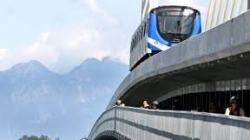
Well, no. It wouldn’t be just like that. Even the vaunted public-private partnership that came together on the Canada Line was ultimately two-thirds public and one-third private. Four levels of government (including the Vancouver airport authority) put up about $1.3 billion of the final $2 billion cost. The public sector owns the asset while a private consortium designed, built and operates it on a 35 year concession. There were construction milestones put in place, ridership levels that need to be maintained. Essentially 8 years from initial decision to pursue the project to its completion.

No one expected the mayor to have a fully funded subway plan in place in just over a year. But was it too much to demand an inkling of an idea, something more than a Babes In Arms, hey everybody, we got a barn! Let’s put on a show!

The fact is, Mayor Ford swept aside a funded transit plan for 4 LRT lines with nothing to replace it other than a slogan. Take a look at his transportation campaign video where he promised to build a full Sheppard subway from Downsview station to the Scarborough Town Centre and… and replace the Scarborough RT by extending the Bloor-Danforth subway all the way to McCowan. In time for the PanAm games in 2015 using just the Transit City money, no new taxes needed, no tolls or congestion fees.

In the nearly 16 months from December 1st, 2010 until last week’s transit vote on the Sheppard subway question, the mayor did little to finesse that plan, to reach out to the private sector, to make a concrete proposal for any sort of partnership. Just trust me, folks. Let’s get the shovels in the ground and see what happens.

Ms. Bird said at yesterday’s seminar that at the point when shovels were about to go in the ground for the Canada Line, she was about 80% certain the project would come on time and budget. (It did on both accounts). There was no such assurance with the Sheppard subway. Not even close. Even in terms of the procurement process seeking a private sector partner for the project, Ms. Bird said that they didn’t approach anyone until they knew, they knew, that the public money was in place.

Ha! Ha, ha! Ho, ho, ho, ho! Double ha!

Our mayor wouldn’t even consider the notion of new taxes or parking levies — all taxes are evil, remember? – despite the begging of his closest allies on council along with his point man on subways, Gordon Chong. As yesterday’s moderator, Doug Turnbull, a Metrolinx board member, pointed out, the lifecycle costs of any transit system including the operational side of things absolutely dwarves the capital costs in building it. So no private sector company in their right business mind is going to enter into a partnership with a government unwilling to even talk about providing a steady, ongoing revenue stream, i.e. taxes, tolls, levies, fees. Ain’t gonna happen, bub.

“I’m not sure we’re always talking about the same thing,” Ms. Bird told the audience when talking about public-private partnerships. She also noted that P3s should not be part of the conversation about what the public sector wants to build. In other words, we shouldn’t build subways based on some vague notion of hopefully, fingers crossed, getting into a P3 arrangement.

This all needed to be directed at the mayor and his councillor brother. Councillor Ford often gets to his feet to lecture his colleagues about their lack of business sense, their fundamental misunderstanding of the private sector. But in listening to those who’ve actually studied or participated in P3s, it becomes crystal clear that the councillor with his family business knowledge is woefully out of his depth. In fact, his deep-seated anti-government sensibilities ultimately disqualify him from having any informed opinion on the subject as he seems incapable of understanding just how key a role the public sector plays.

“The private sector won’t build us a subway because we ask them,” TTC Chair Karen Stintz told the shrieking audience at the first Scarborough town hall a few weeks back. “The private sector will build us a subway because we pay them to.”

That’s the bottom line. No one has ever suggested the private sector does not have a role to play in building transit here in Toronto. That role just has to be fully understood, defined and laid in terms of achievable, affordable goals. Mayor Ford and his ever dwindling contingent failed to do any of those things, failed to even engage in a constructive dialogue about it. The city and those elected to represent the public could no longer afford to wait for him to stop acting petulant and start having an adult conversation.

trumply submitted by Cityslikr
Raging Bullishly On Subways

Following along with Toronto’s ongoing transit struggles, let’s call them, and I have a Raging Bull moment. It’s been a while since I’ve seen the movie but there’s that scene after, I don’t know, the 23rd fight between Jake LaMotta and Sugar Ray Robinson, LaMotta’s lost the middleweight title (or failed to regain it from Robinson), been beaten to a bloody pulp (again) and he staggers over to his opponent’s corner. “I never went down, Ray. You never got me down, Ray. You hear me? You never got me down.”

Kind of reminiscent of Mayor Ford and his Sheppard subway plan, don’t you think?

Leading face first with not much defence to speak of, he just bulls forward, taking shots to the head and body, swinging wildly in retaliation, landing significantly fewer punches than his opponents. “You’ll never take subways from me, Karen. The people want subways, Karen. You hear me? The people want subways.”

Having attended a couple transit meetings and discussions this week and listening to the subways versus LRTs argument, it’s hard not to conclude that it’s really a bit of a mismatch at this point. Proponents of LRTs cite academic studies pointing to the reasons why the inner suburbs of Toronto shouldn’t expect subways, the lack of necessary density being one of the prime reasons why. There’s also the question of money, austere times being what they are. LRTs are less expensive to build and maintain. So, they’ve got cost and suitability going for them.

Subways?

Errrr….. ummmm…. uuuuhhhhhh… They go fast! Downtowners have them. Why can’t the suburbs? Suburban dwellers are not 2nd class citizens. The St. Clair right of way was a disaster! The mayor has a mandate to build subways. The mayor has a mandate!

Did we mention that subways go fast?

Mayor Ford and his councillor brother, Doug, took to the airwaves last Sunday for two hours of unobstructed time (minus the ads, news and traffic reports) to make their subway case. Instead, they talked to Wendel Clark about the state of the Toronto Maple Leafs franchise, chatted Oscars and Norman Jewison and basically recited their transit script (see paragraph 6) over and over again, allowing Councillor Giorgio Mammoliti to chime in with his opinion on the matter. “Hey, guys. Subways are great. Let’s build one under Finch sometime. Talk to you soon.”

No expert testimonials to back their plan. No objective study explaining why building subways would be worth it in the long run. No one-on-one, face-to-face debate with an LRT supporter. Just glib and unsubstantiated rhetoric from a couple knuckleheads with no interest in public transit except as an election issue. Well that, and keeping it off the streets they drive their big vehicles on.

Now, in the final rounds and up against the ropes, the mayor is desperately looking to land a haymaker – boxing’s version of the Hail Mary Pass (in this case case, why don’t we call it the St. Jude) – to try and salvage at least a split decision on the Sheppard subway. Something, anything in order to avoid being completely and utterly sidelined… unless of course that’s exactly what he wants. Like Jake LaMotta, he’s throwing the fight, deliberately losing this battle in order to win the wider war of re-election.

“Now he [Mayor Ford] can argue that, by thwarting him, council denied suburban voters their right to have underground transit like downtowners do,” as Marcus Gee surmised in his Globe and Mail article last week.

So the Sheppard subway isn’t really for the suburbs, the transit deprived Scarborough. It’s for Mayor Ford. Rather than step back and accept the fact that he’s on the losing side of this, that his failure to deliver a feasible, reasonable, sensible plan to replace Transit City that he single-handedly declared dead has left him on the verge of suffering a TKO, he’s picked it up to use a club to bludgeon his way back into the hearts of Ford Nation.

“You never got me down, Ray. You hear me? You never got me down.”

Maybe the mayor has become a little punch drunk.

In a recent Angus Reid poll that showed nearly an even split between those wanting subways and those wanting LRTs, some 57% of those asked said they had no interest in paying tolls, congestion or parking fees, increased taxes to build subways. Pretty much a prerequisite if they’re going to be built. Gordon Chong, the mayor’s handpicked representative to write a report on the viability of a Sheppard subway said as much. As has the mayor in recent days. As has the Toronto Sun.

No, wait. It didn’t. In fact it pretty much called out Mayor Ford for even broaching the subject of increased taxes or any sort of user fees. The Toronto Sun. Called out the mayor. No taxpayer money even if it meant no subways.

The Toronto Sun, people.

But Mayor Ford soldiers on. Even at the time of this writing, he’s holed up in his office with developers, the Board of Trade and a councillor or two, trying to hammer out a deal to get his subway built. There are rumours being floated of a proposal to reinstate the vehicle registration tax that would go to help financing subway construction.

The VRT, people.

This is getting ugly. Somebody outta stop this fight. The mayor’s gonna  get really hurt.

Maybe Mayor Ford shouldn’t be preparing for re-election in 2014. Maybe he should be working on some material in order to play host to some adult cabaret show down in Florida. “I coulda been a contender. I coulda been somebody…”

deniroly submitted by Cityslikr

It Couldn’tve Worked Out Any Better

If he were alive today, think of what a proud papa Mike Harris would be of the municipal government in Toronto that he sired. Maybe he’s smiling down beatifically from Heaven upon his progeny and all the conservative goodness he helped wrought… Mike Harris is dead, right?

(Sorry. Can never passed up the opportunity to pilfer that bit from Stephen Colbert. A few years back, he joked about something that would have ‘Lou Dobbs rolling over in his grave.’ He then turned to ask his crew, ‘Dobbs is dead, right’?)

I was thinking of this as I read through an article Ben Bergen linked to from 1998. Megacity: Globalization and Governance in Toronto by Graham Todd in Studies in Political Economy. Of the many reasons the Harris Tories rammed through Bill 103 in the face of widespread opposition to it throughout the entire 6 cities facing amalgamation, one was particularly nefarious if highly speculative and largely restricted to the old city of Toronto and the borough of East York. It suggested that the neo-conservative Harris was looking to smother the more liberal downtown tendencies under a stuffed suburban pillow that was more closely aligned to his politics. Such thinking gained a degree of legitimacy when the mayor of North York, Mel Lastman, defeated Barbara Hall, Toronto’s final mayor, in the first election of the new megacity.

Now a third administration in and it’s interesting to note that the mayor and his most trusted advisor, Councillor Doug, are from Etobicoke. The Deputy Mayor is one Doug Holyday, the last mayor of pre-amalgamated Etobicoke. The Council Speaker is Frances Nunziata, the last mayor of pre-amalgamated York. The Executive Committee is made up entirely of suburban councillors save Cesar Palacio whose downtown ward butts up against suburban York. A certain pattern emerges regardless of how intentional.

Of course, if we want to dwell on the damage inflicted upon this city, both downtown and suburban, by the ill-thought out amalgamation, there would be worse examples than those currently at the helm. Not a whole lot worse, mind you. But most definitely worse.

To lay the blame for our current fiscal crisis solely on the profligacy of the Miller administration, to spuriously point to the big budgetary numbers that grew during his 7 years in office as even the moderate councillor, Josh Matlow, did on Newstalk 1010 last Sunday, as proof positive of waste and gravy at City Hall, is to suggest that only what happens in the last two years or so matter. It denies history, really, or at least, your grasp of it. Or it suggests you’re just an ideologue.

The provincial Tory view of the reduction of costs through an increase in efficiency with amalgamation was suspect to many from the very beginning of the exercise. (Enid Slack, current Director of the Institute on Municipal Finance and Governance, wrote back in the early days of amalgamation: “It is highly unlikely, however, that the amalgamation will lead to cost savings. On the contrary, it is more likely that costs will increase.”) Most studies since have backed that view up.

In fact, how the Tories went about amalgamating flew in the face of the neo-liberal world view they were espousing. “Flexible forms of governance,” Todd writes, “it is thought, are more consistent with the reality of and necessity for competitive, export-oriented, knowledge-based, whiz-bang approaches to economic development.” So the Harris government replaced 6 smaller municipalities with 1 big, lumbering behemoth and claimed that it would be somehow more efficient? More cost effective? They seemed to have mistaken having fewer local governments for flexibility.

Or maybe they were just using a different definition of the word ‘flexible’. Todd suggests in the paper that unlike previous municipal governance reforms that had intended “…to consolidate the role of local government and the public sector in regulating development…”, the 1998 amalgamation was intended to do just the opposite. It was never about dollars and cents. That was simply a red herring to make the process more palatable. There was still going to be the same number of people demanding the same level of services whether they came from 6 governments or one. At some point of time, economies of scale simply don’t work.

It was all about control of how the city functioned. One government over a wider area was politically more pliable, flexible if you will, and easier to deal with than six. There were more differences of opinions, a wider area of dissension to exploit. Imaginary savings were offered up in exchange for the keys to City Halls. By the time we realized that, what were we going to do, de-amalgamate?

Add to this loss of local control and inevitable rise in costs of running a bigger city, there was that whole downloading/offloading of services onto Ontario municipalities by the provincial government. Cities told to cough up portions “… of provincially mandated social services such as social assistance, public health care, child care, homes for the aged, social housing, disability and drug benefits”. Some, I repeat some, of which have been uploaded back to the provincial government, slowly and on their time line. A $3.3 billion gap according to the Association of Municipalities of Ontario estimated back in 2007.

Of course let’s not forget the de-funding of their half of the TTC annual operating budget that the Harris Government undertook and that has never been reassumed by Dalton McGuinty. Call it $200 million/year that Toronto property taxes must come up with. Add to that the hundreds of millions of dollars foregone by Mel Lastman during his property tax freeze during his first term. A brilliant fiscal move copied by our new mayor on his first budget cycle, along with eliminating the vehicle registration tax and any other form of revenue generation the province had given the city with the City of Toronto Act. No, no. We don’t want that on our hands. We didn’t ask for that responsibility.

Instead, we’ll blame the last administration for our financial woes. We’ll blame the lazy unions and other special interest groups that are looking for handouts. The Gravy Train has stopped, haven’t you heard. The time has come to privatize anything that isn’t nailed down. Sell off lucrative assets too if we have to. Maybe even if we don’t. Everything is on the table.

Yeah, it’s hard not to view our new mayor as the inevitable outcome of decisions made nearly 15 years ago. The offspring, the love child of our former premier. Too bad Mr. Harris didn’t live long enough to see the success his political son had become.

condolencely submitted by Cityslikr