An Open Letter To Rob Ford Supporters

Dear Supporters of Mayoral Candidate Rob Ford,

I’m writing to you not to mock or belittle you, or to denigrate your candidate of choice for mayor of Toronto, Rob Ford. I’ve participated in such easy activities in the past but now want to build a bridge between us. Your man just might win the election in October, so I want to understand how that could possibly happen and how you imagine a Mayor Ford administration is going to help make your lives better. Consider this a letter asking for some clarity from you.

In his column last week, the Toronto Star’s Christopher Hume suggested that Ford represents the suburban anger that has reached a boiling point more than a decade after the enforced amalgamation made us all one. Your concerns have been marginalized by downtowners such as myself, shrugged off while we’ve been busy eating our brie and sushi, sipping lattes and demanding bike lanes, increased transit in the core and conducting our War on Cars, your cars no less.

Fair enough, and undoubtedly true. None of us wanted to be part of the megacity and it seems that those of you living in the outer ring of it in places like Scarborough, North York and Rob Ford’s home turf of Etobicoke feel you got the raw end of the deal. You’ll get no arguments from us here about that. Amalgamation’s miracle of efficiency and money savings never really worked out as well as we were to told it would, especially for you folks out there on the fringes.

Interestingly, Mr. Ford, the fighter for the little guy, takes every opportunity to evoke the memory of his beloved late father, Doug Ford who, as a backbench M.P.P. in the Mike Harris government, sat on his hands during the debate over amalgamation except to raise it in favour of the motion when it came to vote it into law. In direct defiance of over 70% of his constituents, Rob Ford’s father helped usher in an era of municipal governance his son and his supporters now rail against. Nothing more than an example of irony, I guess, but I do hope his father’s anti-democratic tendencies didn’t brush off on his son.

So let’s say your man becomes mayor and is able to muster a majority of the new council to support his way of thinking. (The second scenario much less likely than the first.) A frenzy of cutting taxes and slashing spending ensues. You wind up with a little more money in your pocket and fewer services at your disposal. Now what? How is it your lives are going to be improved because of that?

Transit City – a plan put into place to deliver better service to the areas of the city you live – will be gutted. Replaced by some mystical, magical building of subways your candidate insists the private sector will do for some strange reason that they have not yet thought of. That’s as detailed as his transit plan goes. Aside from making the TTC an essential service, the matter isn’t even referred to in the Issue section of his website. How is that going to get you from point A to B any faster or lessen the traffic congestion that is now part of your life?

I’m also mystified how cutting council numbers in half is going to increase Mr. Ford’s vaunted customer service agenda. I know you love to believe that every other councillor except Rob Ford simply sits around doing nothing more than counting ways they can steal your money except for when they’re partying with Kyle Rae but that is nothing more than an ideological fantasy. Fewer elected officials at City Hall (plus their respective staff) can only deliver better customer service if there’s less services to deliver. Maybe you’re content with that. Fair enough. That’s a different vision than making people’s lives better.

And all that money the city will supposedly save? Even taking Mr. Ford’s numbers at face value which is always an iffy proposition (take a moment to read Simon McNeil’s Writing and Tutoring blog post for an analysis of candidate Ford’s questionable numbers and spotty savings), he claims that eliminating 22 councillors and their staff will save the city $9 million a year in direct savings plus another $6 million due to some sort of nebulous “reduced burden on City Hall staff”. Reduced burden? Would someone please explain that one to me? Less demand on City Hall because it’s doing less?

Even giving Ford the dubious $15 million annual savings with cutting the council in half, what’s that going to do? In terms of a $9.2 billion budget it represents less than a percent. Much, much less. How much less? Let me write it out to 18 decimal points if it helps. 0.0016304347826086956. You know what $15 million will get you in terms of subways even factoring in the lowest estimated cost to build one subway stop? Half one percent of one. So with that cost savings, Rob Ford will be able to build one subway stop every 20, 000 years.* Oh right, I forgot. In Rob Ford’s world the private sector will step right up and build subways once governments get out of their way.
His candidacy just makes no sense to me, Rob Ford supporters, and it’s not like I won’t personally benefit if he becomes mayor. My taxes will go down (although user fees will very likely gobble up much of those gains.) I don’t depend on the city services that a Mayor Ford would attempt to cut. Oh sure, I’ll probably lose a bike lane or two but mostly my life down here in the core will be unaffected if your candidate wins in October. Except that, the city will feel a little more… vindictive.

Because that’s the vibe I get from your campaign. Vindictiveness. It doesn’t feel like what’s driving you is justified anger or outrage. It’s more of a temper tantrum. Rather than fighting to secure a better place for yourselves within the amalgamated city and thereby making the entire city a better place to live and work, you simply want everyone to be as pissed off as your are, as your candidate is.

It’s purely the politics of destruction and wherever it’s been tried before has never made anyone’s life better. How will it work this time around?

earnestly (and unironically) submitted by Urban Sophisticat

* Math may not be exact but it’s no more than one decimal point off. Either way, savings are going to miniscule.

Better Ballots Town Hall

You know, even without any delays it is a long subway ride up the Yonge Street line to North York Centre. I was aroused from my reading material somewhere between Lawrence and York Mills, wondering if I’d read through a stop. You go really fast for a long time which, if my understanding of the physics of motion is solid (and it probably isn’t), means that you are traveling great distances.

Why would you be doing that, you might rightly ask. Heading up to the first Better Ballots Town Hall meeting, I will inform you, held in committee room #3 of the North York Civic Centre, home of the former city hall of the former city of North York. Its empty early evening halls steeped in the history where colossi of the political scene like Mel Lastman once strutted and fretted. The air remains pungent of past power, reeking of… shoe polish. Or maybe it’s the cleaning agent that’s being applied to a floor off down one of the corridors.

Better Ballots, if you don’t know and you should, is an organization committed to increasing voter turnout at the municipal level. The website can give you much better presentation of their mission but in a nutshell: less than 40% of eligible voters voted in the last municipal election in Toronto; 14 of the 44 councillors were elected with less than 50% of ballots cast; only 1 incumbent councillor was defeated while another won his ward with just 20% of the vote; the council make-up is wildly unreflective of the city’s diversity that it claims to represent. Better Ballots wants to change all that.

Local political impresario, Dave Meslin, is the Better Ballots project coordinator and has been toiling away in the margins of election reform for much of the past decade including 2006’s City Idol where 4 candidates were chosen to run for council seats in that year’s election. He chaired last night’s town hall in an amiable but focused manner, promoting inclusiveness with the 25 or so of us there while not allowing things to careen too far off topic. Like any good promoter of a cause, Meslin made sure to surround himself with other smart, articulate advocates.

There was Desmond Cole, one of the winners of the City Idol project, and now an organizer with iVote Toronto. Another Better Ballots representative, Rob Newman, talked about campaign finance reform. Julia Deads from the Toronto City Summit Alliance moderated the town hall portion of the meeting, gently but with the necessary firmness to keep the proceedings flowing. If I had any claim to being an actual journalist, there were a couple other members of the panel whose names I would’ve made note of but didn’t. One was from Fair Vote Canada, a group promoting more proportional representation at all levels of government. I want to say Jeff Peck but, maybe somebody out there who attended the meeting with much better powers of observation could correct me on that. [It was Mark Greenan not Jeff Peck from Fair Vote Canada who were referring to. Thank you to mayoral candidate Sonny Yeung for clearing that up for us. — ed.]

The intent of this town hall meeting (and the 3 others planned at various city locations throughout April) was twofold. The first was to present 14 proposals for discussion about possible reform. These included such things as extending the vote to permanent residents and lowering the voting age to 16, the pros and cons of municipal parties and term limits, several options on ballot structures and districting and the above mentioned campaign finance reforms.

Along with providing information, these town hall gatherings are also about promoting advocacy. Ideas are all well and good but they die on the vine without a movement to take them to a wider audience. The second aim of the meetings is to initiate a grassroots movement to begin pushing for the reform options that garner the most interest from those who attend the meetings and vote on the ballot provided.

Despite what you might think, grassroot movement making ain’t pretty. It’s not all Julia Roberts’ Erin Brockoviches and Meryl Streep’s Karen Silkwoods but rather a long, tough slog through outsider-ville. For every smart, dedicated activist and proponent, there are those who wear their exclusion from the mainstream loudly and proudly, sometimes hijacking the proceedings to grind an axe or to just simply have their voices heard. This manifested itself last night when a handful of mayoral and council candidates took the floor to speak their minds. More campaigning than listening, they mostly took up time and space rather than contributed to the discussion.

Still, the dialogue was far more informative and exciting than any of the claptrap and bullshit that has passed for debate and deliberation so far in campaign 2K10®©. These people truly want to change how things are done in Toronto and to explore the ideas that will ultimately translate into electing those who best represent the widest community views at City Hall. It was time well spent on the subway hearing them talk about it firsthand.

dutifully submitted by Cityslikr

Personality Mapping By Numbers

So apparently, if going by where I live is indicative of the type of personality I possess, the good folks at the Martin Prosperity Institute at U. of T.’s Rotman School of Business would conclude that I am a fairly disagreeable introvert who is mildly conscientious but very open to experience with nary a hint of neurosis. Or, I am none of those things but live amidst a high concentration of that type which, at first blush, sounds nothing like my neighbourhood at all. Or maybe the disconnect is due to complexity being shoe-horned into ill-fitting boxes. Like the evil stepsisters trying to cram their big, flat feet into the tiny glass slipper Cinderella left behind.

All of which has to do with an interview I came across recently with Dr. Kevin Stolarick, a Research Director at the MPI. He and his team amassed a database of some 1300 participants from an online personality test in order to discover a link between types of people and where they live. According to Stolarick, personality traits fall into five and only five categories. “No matter what you ask people in behavioral questions,” Stolarick told Meghan Lawson of The Strand magazine last fall, “their answers always fall into the Big Five traits.” The Big Five? Conscientiousness, agreeability, openness to experience, extroversion, and neurosis.

Really? Do our lives break down that cleanly into a mere five categories? Can a 7 million year march through human evolution only have brought us to a point where we can be psychologically fitted into so few, easily defined slots? Sounds more like a marketer’s dream rather than anything even closely resembling reality.

There is also the very real possibility I just don’t have the necessary academic underpinnings to fully comprehend what Stolarick and his colleagues are attempting to do with this study. Into which one of the big 5 personality trait categories is ignorance placed?

It also could be my misgivings about putting much credence into self-reporting tests that serve as the basis for the research of Stolarick et al. As honest as people think they might be, there’s always going to be a hesitancy to ascribe to oneself less than flattering attributes. Do you like to acknowledge the fact that you’re the type that does ‘get nervous easily’ and ‘can be tense’ and ‘who worries a lot’? Wouldn’t you much rather be that person ‘who remains calm in tense situations’ and ‘is a deep, ingenious thinker’? Even just a little? Agree? Strongly disagree?

I gather that there’s a growing science behind putting together a more reliable sort of questionnaire in order to weed out the biggest, fattest liars and that there’s always increased accuracy in larger numbers, still… I find it difficult to fully embrace the veracity of the responses to such intensely personal questions. No, I am not comfortable admitting, even to someone at the end of a fairly anonymous online survey that ‘I see myself as someone with few artistic interests’ and ‘who starts quarrels with others’?

How much information should be deduced from such exercises? Can useful specifics be gathered from such broad strokes? Even Stolarick thinks that “personality is one of those things that doesn’t change very much. These are underlying personality types. Ideally, you should be seeing that these types don’t correlate with anything else.” So, what exactly is he looking for in crunching these types of numbers?

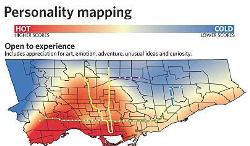
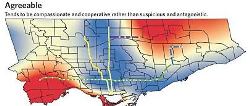
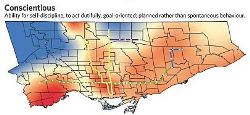
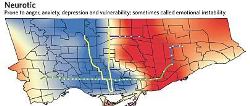
On the plus side, some pretty pictures have emerged from the MPI personality study, using heat diagramming that tells a tale of self-described types and where they reside here in Toronto. It seems that anyone lacking in curiosity lives up in the north end of the city. While all us suspicious and bad-tempered folk inhabit the central region top to bottom (making North Yorkers both close-minded and unfriendly) and stretching out along the lakeshore through the Beaches and into Scarborough. And if you’re neurotic, you better find yourself a place east of Yonge Street unless you want to go around feeling all conspicuous over here on the laid back west side, yo.

It all seems so narrow and confining, if you ask me, especially coming from a think-tank operating under the direction of urban guru Richard Florida. Isn’t he always on about the strength of diversity? Just how diverse are we if we can be so clinically boiled down to 5 kinds of personalities who huddle around other like-minded people? That, to my very open mind with all its introverted disagreeability and ever-so-slight traces of conscientiousness and neurosis, is the exact opposite of diverse; evoking more societal patterns in the Appalachians or medieval Europe. Surely, the complex web of life in a 21st-century, multicultural city like ours goes about its business on a much more complicated level than that.

very unneurotically but quite disagreeably submitted by Urban Sophisticat