Scenes From A Life With Cars

Three car themed vignettes today, all crashing to one inevitable conclusion which I won’t spell out directly, leaving it up to the reader to arrive at on their own. Hopefully, it will give the post an art house film feel.

Yesterday the McGuinty government announced a $1 billion eastward extension of the 407 highway, sounding as if it were some revolutionary act of patriotism. “Our intention is to ensure that this is a people’s highway, owned by the people, tolls are set by the people, service standards set by the people and the revenues that are generated are returned to the people.” And this road, this getter of the people from point A to point B, shall be known from this time forth as the Volksroute!

I don’t have the information at hand to judge if this is a good use of money or not. At least they’re tolling it, so drivers will be paying more for the pleasure of using it. As to a new highway ‘tackling congestion’ as the CBC site claims? There’s little evidence to prove such a case. Google the question do more roads reduce question and judge for yourself. What jumped out at me was this point in link #3 from a U of T study: For interstate highways in the densest parts of metropolitan areas we find that vkt [Vehicle Kilometers Traveled] increases in exact proportion to highways.

I only wish that our premier would embrace the building of public transit with the same kind of grassroots gusto he has for the 407. His support of Metrolinx and its Big Move has been what we might call mercurial. An initial enthusiasm perpetually dampened by an eye on the bottom line. One could argue that, along with the David Miller administration’s failure to really get out and sell the idea of Transit City to the people who would benefit from it most, the Liberal’s quick trigger finger in reducing funding for it in the face of the economic crisis of 2009 made the plan seem, if not expendable, at least elastic to those intent on doing it harm.

Public transit, it seems, is for downtown elites. Highways are for the real meat-and-potatoes, drive-through Tim Horton’s salt-of-the-earthers.
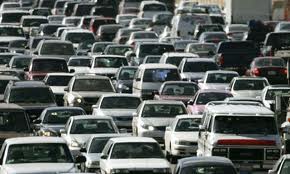
[Cue awkward segue.. A traffic jam as far as the eye can see, under a menacing sun cutting through a smog filled sky. The sound of blaring horns slowly fades into those of hockey sticks on pavement; angry shouts of drivers are replaced by the gleeful peels of joy from kids playing road hockey. The scene of traffic congestion dissolves to a leafy neighbourhood street, curiously devoid of any cars. Only children, boys and girls, all races and creeds, together playing road hockey.]

It seems Councillor Josh Matlow’s quixotic quest to end the city’s ban on ball hockey has come to a stultifyingly bureaucratic end. Too much red tape for many of his colleagues although the idea and its demise provided plenty of opportunity for hockey related puns. So there’s that.

I got no particular dog in this hunt nor do I blame the councillor for pulling the plug in the face of what seemed to be certain defeat certainly at the committee level. Is this an issue you’d waste political capital on? It’s the source of the alleged bureaucracy that grates.

As explained on the councillor’s site, the determination for allowable road hockey would be based on the level of car use. “The street would have to have a speed limit of 40 km/h or less, 1,000 or fewer vehicles passing per day, an average gap between vehicles of one minute or more, and sightlines sufficient to allow vehicles to stop before crashing into the goalie.” In other words, kids, streets are for cars. Sharing is entirely up to them. Maybe if you ask nicely and there’s not too much red tape involved…

Think I’m just being petulant? Read Confession of a former engineer. It seems road/street design runs contrary to how many of us think a proper neighbourhood/community should flow. 1) Traffic speed 2) Traffic volume 3) Safety 4) Cost versus 1) Safety 2) Cost 3) Traffic volume 4) Traffic speed. It’s a car’s world, man. We’re just allowed to live in. Unless we get in their way, of course.

This sense of entitlement defines our 3rd car tale. (Oooo. Seamless transition. Well done.) And it’s a story that actually happened to me. So it has a more gritty, hand held, verité feel.
Earlier this week I picked up an Autoshare car for a couple hours. Yes, as a matter of fact, I do drive occasionally. As a reminder why I fucking hate it so much. And to pick up items that are too big to fit in my bike baskets.

Chores and loathing finished, I returned the vehicle only to find someone parked in the spot. Right in front of a sign clearly indicating it was reserved 24 hours a day, each and every day. No parking. Yes, that includes you, dickhead.

This ought to be interesting I thought, never having encountered such a problem before. With no other place in sight to leave the car, I honked the horn a couple times, thinking that the driver might be within earshot, knowing they were illegally parked. Nothing.

So I called Autoshare, hoping that the solution would be to throw the anchors out right behind the motherfucker and force him to call Autoshare and explain why he thought it OK to park his car wherever the hell he wanted. Unfortunately, no. I was advised to find a place wherever I could in the area, leave it there and let them know the location.

“You’re going to call and have the jagoff towed though?” I asked. “Right?”

Apparently, no. That’s not a thing Autoshare does. It’s more live and let live. Inconvenience rather than enforcement.

I did find a place not far away. But as I finished up I caught a glimpse of a meter guy, walking along a street, writing out tickets. So I raced to find him and point out a certain transgression.

“Excuse me, sir. If you’re looking to fill your quota, some asshole” — yes I do swear this much in real life especially when a car’s involved – “just parked his car in my Autoshare spot. Come on. Follow me. I’ll show you.”

But what do you know? Apparently, this was not an infraction he could ticket. “It’s sort of like private property,” he tried to explain. Unless someone working for Autoshare showed up to complain, his hands were tied.

Shaking my head, I headed home. Unless Autoshare came and moved the car I’d parked from the street in a couple hours or so, it would get ticketed. Ultimately I’d bear the cost in some indirect form or another, as a member of the organization. Some piece of shit would walk away, his wallet none the lighter. Just another freeloading car driver.

THE END

[An addendum: after showing this to a couple test audiences, I was informed that 71% didn’t get it, didn’t see how the three stories were related, failed to understand the point. Some voice-over narration was needed. Don’t worry. It’ll be removed for the director’s cut edition.]

OK, SO NOT THE END

Cars kill cities. Cars kill communities.

NOW, IT’S THE END

auterly submitted by Cityslikr

Going Our Way?

While the cat’s away, we will take about something other than municipal politics today.

Gaze averted for the past year or so from the train wreck that has become the Ford administration, I’ve been keeping myself occupied with the goings-on at other levels of government. Not that there’s a whole lot more to commend from that view either. But at least it lends one a different perspective.

Which is (Segue alert! Segue alert!) what this country is slowly, incrementally facing, a changing perspective. The Albertazation of Canada, let’s call it where the government is the problem not the solution, taxation is a dirty word and all economic problems can be solved by digging into the ground below your feed and mining the resources.

Or as Erna Paris wrote in a Walrus article from March of 2011, “The New Solitudes”: … an outlook more familiar to Americans than to Canadians, at least since the Reagan revolution of the 1980s. Its organizing principles are a powerful commitment to individualism, and to maximum freedom in every sector. Governments should be small, their powers limited, their taxing capacity curtailed. The market must be free and unfettered. Individuals are uniquely responsible for their failures, as well as their successes, and they cannot expect assistance from the ‘nanny state.’

A twist on an old theme, the two solitudes revisited. No longer English and French with its healthy dose of disregard for those here before any European set foot on these shores. But a new division, grounded in western alienation that may be less geographic than it is philosophical. It’s not that Alberta ever wanted in. They wanted the rest of Canada to be more like them.

Or maybe it’s nothing more than sour grapes written from the heart of what was once the economic engine of the nation. The tables have turned. Power has shifted. Money talks, baby, and these days it’s the west with the deep pockets, Canada’s sugar daddies. The new payer of the piper gets a different tune played. If you want to keep dancing, you better learn the new steps.

Not so fast there, bucko. There’s nothing radical going on here. It’s simply business as usual. What we’re witnessing from this long feared stable Conservative majority government is little more than a slightly bluer tinged Chrétienism.

Take last week’s federal budget for example. Nothing out of the ordinary, no draconian hidden agenda. The new normal. Nothing to see here, folks. Everybody back to work.

You see what just happened there?

It is now taken as a simple matter of fact, plain as the nose on your face that government deficits and debt are due to excessive spending. On bailouts and stimulus spending during the global economic crisis. On pensions and other outrageous luxuries afforded to those not willing to do an honest day’s work in the private sector. We are all now true believers in the Rob Ford maxim that governments have a spending not a revenue problem despite all evidence to the contrary here in Toronto.

Buying into that mantra, Dalton McGuinty’s Liberal government in Ontario instructs Don Drummond not to even consider new taxes as a way of helping to alleviate the provincial deficit. This is a spending problem, remember? Tell us how to spend less not how to generate more revenue.

The flip side of this leap of faith, this embrace of the Alberta way, is that low taxes, cutting taxes creates a robust economy. It’s that simple, people. Although the Ontario government in its recent budget put off further corporate tax cuts, it was seen as a concession, a sop to keep the NDP happy rather than an admission that having slashed the rate over the last few years has generated little economic benefits to anyone but those businesses now paying less tax.

Lower personal income tax rates and the reduction of the GST at the federal level have also proven to deliver somewhat illusory economic benefits. Yet there’s nary a mention of that in much of the budget coverage. Little analysis to challenge the prevailing orthodoxy blowing in from the prairies. Taxes are bad, evil even to some minds. End stop.

No, the only way to turn this ship around, to build a sustainable economy, is to dig our way out. Addition by extraction. Ontario? Quebec? Stop expecting handouts from the rest of the country and get mining. There’s gold (of something else valuable) in them thar hills. Drill, baby, drill!

You see, according to the Alberta way, green may be good in theory but terrible in practice. Where’s the money to be made in wind, solar? Ontario’s very tentative baby steps in that direction have proven to be a bust to those inclined to view alternative energy with scepticism. Nothing more than a vain hope in the eyes of the Globe and Mail’s John Ibbitson.

Never mind what’s been going on over there in Germany, say. That country propping up the European economy at the moment. Its embrace of solar and wind power has helped turn around moribund manufacturing areas in the former east bloc parts of the country. In just 12 years, green energy went from contributing 6.3% of the country’s energy output to now over 20%, creating over 300,000 jobs in the process.

Hmmm, revive a flagging manufacturing base. Reduce dependence on unsustainable fossil fuel sources. Seems like a win-win strategy to those not wedded to the Alberta way.

Unfortunately, there’s little boldness in leadership in that direction currently. Politicians of all stripes have accepted the handcuffs of fiscal restraint to dampen expectations of new ideas and nip any discussion of charting a new course in the bud. Hewers of wood and drawers of water we once were. Hewers of wood and drawers of water we shall continue to be.

Those of us demanding something different are now another solitude, looking forward rather than backward. With a majority federal government intent on reshaping the country and its institutions bit by bit into a decentralized, corporate-minded, neoconservative plaything, we may have to take the prime minister up on his offer to seize more regional autonomy and assume control of our future. A future divergent with the Alberta way. That, to borrow Erna Paris’s title, is our new solitude.

sneakily submitted by Urban Sophisticat

Childish Behaviour

I could not disagree with Christopher Hume more if he were, well, Rob Ford.

He’s plea to the province to assume control of Toronto’s transit file is nothing short of madness, an adolescent whine. I want my mommy. Send lawyers, guns and money. Dad, get me out of this.

Long has been my stance, if not in these pages than in discussions I’ve had, that the main reason voters in cities including here seem comfortable casting their ballots at the municipal level for, how to say this delicately, clowns, clowns, jokers, the inept and certifiably deranged, is because they believe that it doesn’t really matter. There’s this blind faith that regardless of what happens, no matter what shit we manage to cover ourselves with, there’s a safety net to break our fall. The province would never let us burn our playhouse down.

We are the junior level of government, the farm team if you will, the bush leagues. Expectations are low, so why not have some fun with it? Politics as performance art. Since there are no consequences, we can afford to take a flyer or two, an appliance salesman here, a blustering buffoon there. It’s not like it’ll make any difference to our lives, right?

As we’re slowly beginning to realize, that’s not in the least bit true. In fact, it’s downright misguided from where we’re standing. Municipal politics matters. A lot. But to scream for a lifeline now, to call for the cavalry only reinforces the already hardened preconception that we’re not responsible enough to take care of ourselves. That when push comes to shove, we’re happy to hand over responsibility to the adults in the room and let them sort through the mess we’ve created.

And even that’s more than a little galling. In terms of public transit in Toronto, we are hardly the chief culprits in the bind we’re in currently. Plenty of blame to go around, with Queen’s Park topping the list. I mean, hey. If cities are nothing more than creatures of the province than the province has to bear some of the burden in how we’ve turned out, right?

Imagine if you will, the Mike Harris government (and yeah, I’m looking hard at you, Councillor John Parker) not filling in the hole that had already been dug in Eglinton Avenue back in 1996. This whole above/below ground LRT battle would be moot. We might even already have a Sheppard subway extension! Or what if the McGuinty government had long since made good on its promise to re-upload it’s portion of the annual TTC  operating budget that their predecessors had wiped their hands clean of (again, I’m looking hard at  you, Councillor John Parker)? That’s hundreds of millions of dollars Toronto would’ve had in its coffers or been able to give to the TTC for expansion or state of good repairs. Maybe had Premier McGuinty not wavered back in the spring of 2010 and scaled back on some of the original Transit City plans, then candidate for mayor Rob Ford wouldn’t have seen it as negotiable. Maybe had Premier McGuinty not wavered again, this time in the face of a Mayor Rob Ford, and signed their Memorandum of Understanding, throwing all transit planning back up into the air.

These are the people Mr. Hume wants to take charge? Arguably the very architects of our transit disarray? What on earth will that accomplish?

Despite Mayor Ford’s continued intransigence, city council is getting a handle on the situation. Doddering patrician types like the National Post’s Terence Corcoran sniffs at the February 8th city council meeting that asserted council’s primacy over the mayor, calls a timeout and declares we should just start all over. Well you know what, Mr. Corcoran? Fuck you. Democracy’s messy.

If people would just accept the fact that Mayor Ford lost, that city council (re)approved the Transit City plans for the Eglinton and Finch LRTs, that in a sop thrown to the mayor, a panel will make recommendations about Sheppard Avenue next month, we could just get on with things. Ignore the petulant child jumping up and down, holding his breath and turning red in the face. It doesn’t matter. Paying attention to him only reinforces the grade school view of municipal politics.

As does asking the province to come in and sort our problems out. Ironically, it also puts the normally fierce critic of the mayor, Christopher Hume, on the same side as the man he so obviously loathes. You don’t think Mayor Ford would love to divest himself of public transit decisions? Here, take it and all the related costs. Then we can just bitch and moan if it doesn’t work out to our liking, blameless. Take our traditional place in the backseat, counting on our parents to get us to where we’re going and only asking over and over, are we there yet? Are we there yet?

We’re not but we also need to realize that dad’s handed us the keys to the car.

adultly submitted by Cityslikr