Boxstore Aesthetic

There’s not much I can add to the discussion about this week’s decision by the Public Works Committee to kill the Fort York pedestrian bridge that hasn’t been already said more fully and completely by Derek Flack at blogTO and Ford For Toronto’s Matt Elliott. Except maybe to introduce a new word to the English language. Derived from a combination of despair and anger that has become the prevalent mood here in Toronto during the Mayor Rob Ford era. Angair? Desger? Despanger? (Try it with a French pronunciation. Day-PAN-jay.)
How many times and ways can we talk about myopia and short-sightedness? Pennywise and poundfoolishness. The stunted notion of ‘core services’ being seen as little more than roads and sewers and not the wider, longer view of all round liveability.

That the public face of the move to kill the bridge is Councillor David Shiner comes as no surprise. He is part of the core group of Team Ford whose prime motivating factor seems to be, even more than simple political ideology, exacting revenge on anyone or anything from the Miller administration for excluding them from positions of power or influence. Once the mighty budget chief under Mel Lastman, Councillor Shiner was reduced to outsider status during the David Miller years, and somebody has to pay for that slight.

He couldn’t really have bagged a bigger prize, either, than the Fort York bridge. Not a big ticket item money-wise (less than the revenue the city won’t see from the decision to repeal the VRT), it was the baby of Ward 19’s former councillor and Miller’s Deputy Mayor, Joe Pantalone.  ‘An attack on taxpayers’, Councillor Shiner called the bridge and its ‘fancy’ design. Fancy’s the old way of doing things at City Hall. Austerity (in both mind and matter) is the new fancy.

What’s especially rich about Councillor Shiner’s demand for more financial accountability in somebody else’s ward is that he’s one of the beneficiaries of perhaps the biggest boondoggle… I mean, investment in future development… in recent memory:  the Sheppard subway line. Running through a bottom slice of his Ward 24, we have recently heard the councillor get up and defend the mayor’s plan to extend the subway, extolling ‘the subway to nowhere’’s contribution to a construction boom along its corridor. An argument some have made about the Fort York bridge. Its fancy design would help spur interesting investment around it much more than a Gardiner Expressway version of it might.

It’s also interesting to note that in justifying his decision Councillor Shiner said, “… just think about what that $23 million could do for bridge rehab, for road repair; think of the community centres it could fix up, of the children’s services and child care centres it could provide.” I believe that this is the same councillor who back a few months during the budget debate, grilled a representative from the Toronto Public Library about switching projects after money had been specifically allocated even if timelines and preparedness dictated a strategic change. Doesn’t his rationale about using possible savings from a scaled back version of the bridge on more pressing needs use the same kind of reasoning he dismissed on the part of TPL?

While I’m sure impossible to track, it would be interesting to see how much of any savings that might arise from a new, modified bridge construction Councillor Shriner will then fight to spend on infrastructure upgrades, community centres and child care. Colour me sceptical (which is more or less teal-like) that’ll be the case. Instead, I see whatever money there is being flushed down the sinkhole created by tax cuts and freezes, and the fundamental ill-will the conservative faction at City Hall bear toward generating revenue.

The fate of the Fort York bridge is the inevitable outcome that arises when politicians elected on a platform of respecting taxpayers not citizens gain power. There’s no bigger picture outside the bottom line. Why do anything special or fancy when it can be done for less money? Imagine the oodles of dough saved for Paris way back when if Napolean III told Baron Haussmann that his plans were all pretty and such but let’s scale it back a little, shall we. Why build a stage with a Frank Gehry proscenium arch (to use an example from one of the mayor’s favourite cities, Chicago) when a concrete band shell would work just as well?

despangerly submitted by Cityslikr
The President’s Man Goes Local

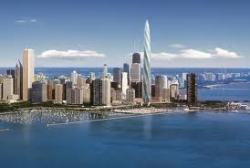
So Rahm Emanuel resigned his post as chief of staff to the most powerful position on the planet (after, that is, the top 5 places within the Chinese government structure) to run for the mayoralty of Chicago. This is a guy who served for three terms in the House of Representatives. He’s now running to be mayor of Chicago. A power broker inside the D.C. Beltway packs it in for what looks to be a rough ride of an election in the 3rd biggest city in America.

Does that strike anyone else as a step down a rung or two of the success ladder?

I mean, aren’t mayor positions simply consolation prizes for those without the goods to make it big at state/province or federal levels of government? It certainly seems to be the case here in Toronto during this particular campaign cycle. Also-rans and not-quite-good-enoughs battle it out for ultimate supremacy of this backwater burg we call home.

Yet, here’s arguably the meanest, nastiest and most successful backroom Democrat in recent memory heading out of Washington to try his luck running for the lowly position of mayor. Obviously it’s some sort of punishment being meted out for the crime of pushing President Obama too far to the middle. Yeah, thanks for all your help, Rahm. How be you just run along now and try your hand at local politics?

Or, maybe this is a case of an extremely motivated politician realizing just which way the wind is blowing, where the action really is. Cities are where it’s at, baby. In this globalized world of increasing urbanization that we’re living in, cities are assuming control of the agenda, the engine driving innovation, sustainability, diversification. What politician with an elevated sense of self-importance (one can posses that trait in a good way) wouldn’t want to be at the forefront of all that?

Gazillionaire Michael Bloomberg, touted as a possible independent candidate to run for the presidency of the United States, takes a pass, opting instead to stay as mayor of New York City. In Los Angeles, Antonio Villaraigosa dabbled for a time in California state politics before moving into the municipal arena, first as a council member and then mayor. Portland Oregon mayor Sam Adams has burst onto the national scene as a leading advocate for building environmentally sound cities. So famous has he become that a beer has been named in his honour.

But over the course of Toronto’s dreary 9 month campaign so far, we’ve been told it’s just about filling potholes and fixing street lights. After 7 years of tentatively stepping toward the future, all we’re hearing now is what we can’t do, not what’s possible. Voters are cowering in the face of necessary and exciting change; their fears and worst instincts catered to by unimaginative candidates who seem oblivious to the shifting sands of where power is headed. We imperil our ability to adapt to what’s coming and thrive in the possibilities that will arise if we hand over the levers of power to someone incapable of seeing past nickels and dimes.

Rahm Emanuel seems to understand this. He’s angling to take the reins of a great but deeply troubled city. Much more troubled than even the worst case scenario being painted about Toronto by the hysterics contending for the mayor’s position. Chicago’s money woes are significantly worse than ours. Allegations of actual corruption and cronyism have stuck to some of the outgoing city officials. Crime is a significant problem there and not just a convenient bogeyman being shaken around in order to frighten voters.

Despite all of that, Rahm Emanuel wants to be the mayor of Chicago. There’s an element of flight, certainly, from an administration looking to take a hit in next month’s midterm elections. If it does happen, there’ll be plenty of fingers pointing at Emanuel as a prime architect of Obama’s fall from grace. But he could run toward a much more lucrative spot in the private sector, assuming such a thing exists anymore which also might explain the President’s low approval ratings.

Emanuel’s decision to follow in the footsteps of Richard M. Daley bespeaks of how important cities have become on the political landscape. Those accepting that new reality have begun to assume responsibility for proper future planning, at times defying upper levels of governments by setting more stringent environmental targets and broadening personal rights and freedoms. In the vacuum created by the divestment of powers by successive federal and provincial/state governments as a way to balance their books, forward thinking cities have assumed the responsibilities and set out on a course to not only remake themselves in a 21st-century fashion but the regions and countries that they are part of as well. Savvy politicians like Rahm Emanuel recognize that and are jumping at the chance to get involved.

It’s unfortunate Toronto has been hijacked by mayoral candidates more content to wallow in petty grievances and almost tribal hostility instead of generating ideas about how best to move into a future where cities will be at the forefront of policy decisions and societal change. If the next mayor doesn’t understand that and seize upon it, all the advantages we as a city have presently (and we have many) will be for naught. Our enviable position cannot be translated into expanded opportunity by merely filling potholes and fixing streetlights. We need to stop shying away from thinking bigger.

civically submitted by Urban Sophisticat

A Labour Day Thought Worth Repeating

Because it’s the last long weekend of the summer, and because it’s rainy and dreary outside, and because we’re lazy, and because we’re still reeling from the realization that Nicholas Cage can actually still act, having watched him in Herzog’s Bad Lieutenant last night, because of all this, we’re bringing you our first, official repeat column.

Hey. Everyone’s doing it. It is still summer after all.

We’re not entirely laying a turd on you or anything. It will be topical. Since it’s Labour Day, we’d thought we’d replay the column written by our colleague, Acaphlegmic, on May 1st. The Other Labour Day.

It’s just as pertinent now as it was way back then, perhaps even more so. As our municipal campaign has heated up, the anti-labour/anti-union rhetoric has only intensified. To some of our politicians and their rabid followers, city unions and workers are a big part of the myriad of problems the city faces. Just like the auto workers were when they were asked to take pay and benefit cuts to help out their poor, beleaguered employers. If only they wouldn’t demand so much, maybe the industry wouldn’t have found itself in the dire straits  it did.

Yeah. That was the problem.

The face of labour may be changing but we should take a moment today and stop to remember that much of what we have, like the first day in September being work free for many of us, is not due to the munificence of the markets or the beneficence of our bosses. It is because of the sacrifice and willing to risk life and limb of those who were truly fighting for the little guy. Lest we forget.

A Good May Day To You

It’s May 1st. May Day. International Workers’ Day.

It always brings to mind the scene from Monty Python’s Life of Brian where the revolutionary groups are discussing life under the Romans.

To paraphrase slightly: What have the unions ever done for us?

Modern May Day “celebrations” can be dated back to the late-19th century as a commemoration of Chicago’s Haymarket Massacre in 1886. Twelve people died (including 7 policemen) when a bomb was thrown during a labour demonstration that was held calling for an 8 hour workday.

How quaint. An 8 hour workday. What kind of starry-eyed idealists were these that believed such things possible? If there are those out there reading this who pay their rent/mortgage, put food on the table and are ready to finance their childrens’ university education, all on an 8 hour workday, raise your hands.

It’s one thing to ask to work only 8 hours a day/5 days a week but another thing entirely to expect to earn a proper living on it. For at least the last 30 years wages have stagnated for the middle class as it shrank in size, squeezed from both burgeoning top and bottom ends. Simply to maintain economic ground, most people have had to work longer and take on increasing amounts of debt.

Occurring simultaneously, union membership has fallen. In the United States, more than one-third of employed people belonged to unions in 1945. By 1979, union membership had fallen to 24.1 percent. Thirty years later, union workers only made up 12.3% of the work force.

A coincidence? Perhaps. We are not unaware of the fact that correlation does not imply causation. There have been many factors, oftentimes interrelated and interdependent, over the past 3 decades that have contributed to the growing fiscal imbalance between work and pay. Still, it is funny that in these days of economic struggle unions and those that belong to them are derided and dismissed as lazy fat cats, bloodsuckers and artifacts of the past.

Of course, May Day festivities and revels long pre-date unions and workers. They go back to pre-Christian, pagan seasonal rituals denoting the end of the long, dark winter in the northern hemisphere. According to Celtic legend, bonfires were set alight at strategically important sites to “mark a time of purification and transition”.

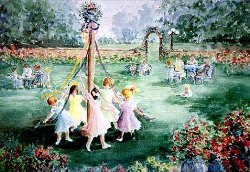
Maybe the time has come to meld the two traditions, modern and ancient. How be we burn some shit down to purify and transition to a more fair and equitable era? And then we can all dance happily around the Maypole.

revolutionarily submitted by Acaphlegmic