Retail Politics

You’re the best retail politician in the country!

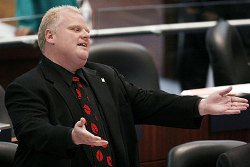
On this, Councillor Doug Ford and I (and the Toronto Star’s Daniel Dale) could all agree. everythingmustgo1Mayor Rob Ford is indeed a fantastic retail politician although, unlike his councillor-brother, I haven’t seen every politician in the country so can’t really make the complete comparison. But certainly, the mayor just might be the best I have ever witnessed.

Now, you might consider that a startling confession if retail politics was something I was looking for in a politician. Unfortunately (for me), it isn’t. In fact, it’s the kind of populism I abhor in those seeking public office.

When I think of retail, I think of somebody trying to sell me something I don’t need at a price I can’t afford. Pandering also springs to mind. What do I have to say for you to buy my product?

According to the etymology of the phrase, ‘retail politics’ meant ‘buying votes’. salesman1Hardly the most flattering of descriptions for a politician and probably not the way we think of the phrase these days. It’s more, tell me what you want to hear and I’ll say it. You don’t like paying taxes? Let’s cut taxes. You hate streetcars? Me too. Let’s get rid of streetcars.

It’s more complicated than that, of course. Like any good retailer, it’s about shaping the perfect pitch for your product to the consumer. Snappy slogans, easily committed to memory. Political jingles, really, that stick in your mind and spring up unexpectedly years later.

“Marine Land and Game Farm!”

Stop the Graa-Vee Train! The city’s got a spending not revenue problem. The city’s got a spending not a revenue problem.”salesman

(Yeah. I’m more of a word than a tunesmith.)

Retail politicians essentially sell themselves to the voting public, complete with easy to follow labels and instructions. Their policies are usually just extensions of their personalities, extra bonus add-ons that come with the full package. Pick me and I’ll freeze property taxes. Pick me and get subways.

At least since amalgamation, Toronto seems to love its municipal politics retail. The very first mayor of the place was in fact a salesman. Who voted for Mel Lastman? Ev-er-ee-bo-dy!

Now, Mel served in the capacity of mayor since 1972 up in North York. Over the course of 30+ years, he certainly refined his product to suit the changing political landscape but, ultimately, it was always Mel people voted for, salesman3and his pledge to keep taxes low and the government small. Who wouldn’t want that?

The problem with retail politics, however, is that they’re very, very limited in their scope.

If you buy a carton of milk from the supermarket, for example, you don’t go back there to get the brakes of your car fixed (except maybe at some Walmarts). You shop at a supermarket for supermarket-y stuff. You take car problems to a garage with a qualified mechanic.

If the city you live needs more than lower taxes and small government, like say a transit system or other infrastructure requirements, politicians who promised nothing more than low taxes are kind of out their depth. In fact, the bigger matter of governance in general may well be beyond their grasp or even interest level. Whoah, whoah, whoah. Pilgrim. I promised to look out for the little guy not build them a liveable city.

The complicated nature of big city politics finally took its toll on Mel Lastman in his 2nd term as megacity mayor. mellastmanIronically when it came to selling Toronto to the world in an Olympic bid, he came out embarrassingly flat and awkward. He was hopeless during the SARS crisis. Lobbyists filled the void created by his increasing disinterest in the actual day-to-day running of the city.

We’re witnessing a very similar failure of retail politics, much earlier in his administration from Mayor Ford. In the face of the severe storm on Monday and with much of the city’s infrastructure under duress, he was nowhere to be seen. The press conference he eventually participated in the day after was perfunctory, as most of his press conferences are. He toured some of the sights still struggling with the excess of water and stared blankly at them.

“There’s no doubt about it. We do need infrastructure. We just have to fund for it,” the mayor said.

Funding. The billion(s) dollar question, and one the best retail politician in the country is ill-equipped to answer. How to invest in infrastructure when all you promised to do was lower taxes and reduce spending. deathofasalesmanHe’s already come up empty on the promise to build more subways in Scarborough. It’s hard to imagine how the mayor can be a part of this solution.

But he’s not to blame for that.

On the campaign trail, he told us what he stood for, what he planned to do if elected. Sure, he polished some rough policy corners but what retailer doesn’t buff out the blemishes of their product? Buyer beware, right?

We bought what Rob Ford was selling us, so it’s unfair to expect that he has anything much of value to contribute to this ongoing discussion of city building. That’s not his product. Anyone reading the fine print would’ve known that.

sellingly submitted by Cityslikr
Putting Ourselves Between A Rock And A Hard Place

On the other hand…

hmmmm

It was gently asked of me yesterday that if the characters in the current $150 million pooling-uploading saga now swirling around City Hall and Queen’s Park were different – like, say, a mayor I didn’t see as a raging incompetent or a provincial government I felt was more Mike Harris-y – would my reaction be the opposite of what it was. Essentially, a variation on the why is he so fucking incompetent theme. A fair question.

Yes indeed, the Liberal government is getting away with some dubious claims in this transaction, using Mayor Ford’s epic inability to get along with absolutely anyone and everyone he doesn’t see eye-to-eye with as cover. letmestopyourightthereAs John McGrath pointed out on Friday, over the course of the 3 year phase out of the $150 million pooling fund, the city will ultimately be short-changed just over $13 million after factoring in the uploading of services back to the province over the same period of time. (The chart is on page 5 of this letter sent to the mayor’s office by Finance Minister Charles Sousa.)

Of course, Mayor Ford muddies the waters with his immediate ballistic response, threatening to cut social programs to the tune of $50 million next year when, in fact, the pooling fund-upload exchange will net the city an additional $700,000. It’s hard to believe there can’t be some financial re-arranging at the city level to mitigate the need for any cuts. It’s also hard to believe the mayor would be willing to go into an election year with the mess of significant cuts to social programs on his hands in the hopes voters follow him in pinning the blame on the provincial government. No service cuts. Guaranteed. Remember?

This is all purely political jostling on everyone’s part. It’s just unfortunate, if not at all surprising, the Liberals decided to play along. pissingmatchA solid majority of Toronto residents know that we’ve elected a child-mayor who only operates through the lens of campaigning. The provincial government is supposed to be the adult in the room. Instead, they’ve started up their engines in a game of chicken.

In order to try and mask that, the finance minister threw into the pot relief from a loan made to the city by the province back when Mike Harris was premier and Mel Lastman mayor. A loan to cover the initial costs of amalgamation with the expectation of being paid back with all the efficiencies that would be found. Efficiencies weren’t found, so the loan has been ignored for most of its life.

So, the finance minister claims that’s about $230 million in savings for the city but it’s actually Ford level accounting. thanksfornothingIf the city hasn’t made a payment in a decade or and wasn’t expected to, it should hardly count as any sort of savings. Thanks for the gesture, Queen’s Park. As empty as it may be.

The politics of this goes beyond just the war with Ford. The Liberals want everyone to know that it’s not giving any municipality preferential treatment even if there are legitimate reasons it might. If the province is fully assuming the costs of the social programs Toronto bears a heavier burden providing than other cities in Ontario, fair enough. I’m yet to be convinced that’s actually the case.

But the Liberal government under Premier Kathleen Wynne, a Toronto MPP, is petrified of being seen as Toronto-centric by the rest of the province. So no special deals on a casino. No special funding treatment. itshisfaultAs it goes in Kenora, so it goes in Toronto.

It would be unfair to suggest that it’s simply back to business as usual since 1995. The Liberals have reclaimed much of the costs their Progressive Conservative predecessors downloaded onto municipalities in the Great Savagery of 1995-2003. (Certainly not all. For one, there remains the outstanding matter of the provincial contribution to the TTC’s annual operating budget they haven’t made good on.) Let’s give credit where credit is due.

It’s sheer big-balled audacity, though, to point to the city’s annual surpluses as proof we’re sitting pretty while Queen’s Park battles heroically with a debt load that’s kept us all afloat. Lest they need reminding, cities can’t run an operating deficit. They’re not allowed as provincially mandated. dirtyhands1Our surpluses come from conservative budgeting that leaves many of our services (some also provincially mandated but not necessarily provincially funded) and residents more than a little frayed around the edges. It’s at moments like this when it’s worth asking if the province is putting back as much into Toronto as it’s taking out. I’ve never had a satisfactory answer to that.

While it may be politically advantageous at this point to use our bumbling, stumbling mayor as a convenient punching bag, it would do well for the provincial government to remember that there are real life implications to their political calculations. Implications that will inevitably be borne by those least able to bear them. Mayor Ford won’t be among them.

Perhaps the bigger lesson to be learned from this is for the people of Toronto. Queen’s Park and the governments in power there, first and foremost will be looking out for themselves. We’re just part of their always fluid political equation, little more than polling numbers.responsibility

We need to look after ourselves and have been given some of the tools to do so. In order for that to happen, we have to stop electing politicians who refuse to step up and take on that responsibility. It makes us easy prey for those putting their own interests first.

responsibly submitted by Cityslikr

Re-Imagining Toronto III

[On Thursday, March 7th, Idil Burale and I will be hosting a discussion forum at the Academy of the Impossible called, Reimagining Toronto: Understanding the framework of urban/suburban politics. So this week at All Fired Up in the Big Smoke, we’ll be looking at some of the issues that make up the divide of such urban/suburban politics.]

*  *  *countrymousecitymouse2

Throughout the week, we’ve been writing about the political landscape that lead to Rob Ford’s victorious run for mayor of Toronto in 2010. The historical background, the media environment, all the what you might call externalities. More or less an attempt at objective observation.

Today, let me get all subjective and present a frank and full mea culpa. How I played my part in the election of Mayor Robert Bruce Ford. babesinthewoodsA big ol’ ooops.

As cub observers of the political scene in Toronto, All Fired Up in the Big Smoke made its first appearance on January 4th, 2010. The day candidates could officially file with the city. We and Rocco Rossi made our municipal debuts together. Ha, ha. We’re still here.

Councillor Rob Ford as candidate for mayor was still a figment of our feverish imagination. It would be another couple months before he declared his intention to run. The possibility of such a thing merely tickled our funny bone. If nothing else, it would provide a bit of comic relief to the proceedings.

We continued not to take him seriously throughout the spring and early summer. His building constituency had to be fragile, a protest movement with no legs. It wouldn’t sustain itself through the all the missteps and scandals that would surface. When people were confronted with his deplorable behaviour during his ten years as councillor – cllrrobfordthe ‘Orientals’, dead cyclists, drunken outbursts at hockey games and on and on and on – there’d be a collective ‘Eewww’.

Yes, we were guilty of hurling invective, comparing him to Chris Farley, an excellent candidate for manager of a Walmart and on and on and on. Not only did we mock his one-note campaign style and his dodgy grasp of important policies but, unfortunately, we also ridiculed him about his weight and appearance.

When it became clear that Rob Ford had established himself as a serious contender for mayor, we finally had to overcome our disbelief and bewilderment and come to grips with that cold, hard reality. No, that can’t be right. What’s going on? What the fuck is wrong with people?!

On July 14th, 2010, we wrote a post entitled ‘An Open Letter To Rob Ford Supporters.’ By a long shot, it remains our most read piece to this day. (That’s called building an audience, that is.) In it we asked, with as little snark and condescension as we could possibly muster, what was the appeal. Why were they embracing his candidacy like they were. His numbers didn’t add up. His policy planks were wobbly under the weight of sheer improbability. His track record as a councillor indicated no desire on his part to solve the problems suburban voters faced in the amalgamated city.

Nearly three years on, the validity of our concerns holds up. There have been cuts when candidate Ford said there would be none. He’s shaved spending not cut the billions he said he could cut. fordnationHis transportation plan is in tatters, no more thought out than it was in 2010. On most major issues the city faces, the mayor has been sidelined, reverting to the lone wolf councillor he always was.

Yet Mayor Ford has retained his core support. His approval ratings hovering between 42-48%, essentially where they were when he was elected. The conundrum continues.

I don’t share some of my colleagues concern that this makes him re-electable. Sure, given his lack of performance one might think the numbers would be significantly lower. Where they were for his predecessors when Toronto had tired of them, in the thirties and high twenties. But compared to where Mel Lastman and David Miller sat at the same time during their first term? 48% is nothing to be boasting about.

And the news that John Tory hasn’t ruled out a possible mayoral run next year must send shivers up and down Team Ford’s spine. It’s what they feared most in 2010 and fought so hard and under-handily to stave off. biggermanThe appearance of any credible right of center candidate in the 2014 campaign – be it Tory, Karen Stintz, Michael Thompson – will spell the end of Mayor Ford’s hopes for a second term.

But that it’s come to that as the catalyst for a crash and burn of this administration should be mystifying to many of us. A startlingly high number of suburban Torontonians still love the mayor, despite what the rest of us would view as a bad case of the unrequiteds on his part. For our part, we’re still as confused about that connection as we were back in 2010. Now, as much as then, we need to come to terms with it and figure out how to make the case that it is an unhealthy relationship for all of us.

earnestly submitted by Cityslikr