A Sheepish Admission

Standing outside the tent on Saturday night, listening to The Sheepdogs rip through their 2nd set of the day (the first being an acoustic one in the blazing sunshine) at Hillside, my thoughts turned to the 70s. How could they not? Here was a band channeling the spirit of Southern Fried Rock in both sound and look with a touch of The Black Crows and My Morning Jacket thrown in for good measure to a capacity crowd that consisted largely of folks who weren’t even born when this sound first emerged.

Kids these days, with all their rap and bleep-blop electronic music, enthusiastically embracing the more countrified roots rock sound of their parents. Nothing wrong with that although, for me, if I want to listen to the Allman Brothers (an impulse which occurs almost never – my musical taste tends more to the bands that bracketed The Sheepdogs, Hooded Fang and Hollerado) I’ll listen to the Allman Brothers. But certainly, there are worse things to adopt from the recent past as I await the re-arrival of wide, wide ties with some trepidation.
I have mixed emotions about the decade I came of age in. While many of us benefited from the social and political freedoms that opened up as a result of the upheavals of the 1960s, we also wound up stunting them, stopped the march of progress far short of its goals, twisting and bending the ideals into an almost unrecognizable shape that called itself the Reagan (Neo-Conservative) Revolution. In 1969, America put a man on the moon. By 1980, we’d convinced ourselves that government was a problem not the solution. The 1970s just don’t hold up well in that light.

I was still mightily in my pre-teens during the tumultuous year of 1968 but I do remember that mixed sense of fear and, if not hope, a curious anticipation of what might be right around the corner. Protestors derailed a presidential re-election bid in a fight against an illegal, immoral war. Cities exploded in riots, set alight by inequality and racial oppression. Assassinations. First, Martin Luther King. Then, Bobby Kennedy. More riots.
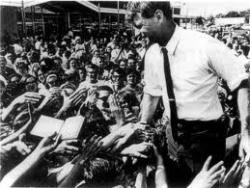
It was Kennedy’s death that we can now see as something of a turning point for progressivism. Not that it was any more important or devastating than the slaying of King but RFK’s journey from his privileged, elite upbringing and early rabid anti-communism to the moral conscience of a country as presidential candidate signaled that the old order was rotten to the core. A fundamental change of course was needed and underway.

And then he was dead.

The politics of spite and tribalism filled the void and prospered. Even the downfall of the petty tyrant of vindictiveness, Richard Nixon, in 1974 only served to temporarily delay the triumphant of reactionism. It emerged in its full blown hideousness with the ascent to power of Margaret Thatcher in 1979, Ronald Reagan in 1980 and so on and so forth.
So by the time those younger Sheepdogs fans began sitting up and noticing the wider world around them, radical conservatism had become the entrenched orthodoxy. We who had benefited from progressive ideas in action – livable wages and working conditions, accessible and affordable health care and education, reasonable expectations of fair pensions and a well earned retirement, all that solid middle class claptrap – had decided that enough was enough. No longer would or should we extend such luxuries. They only served to sap our work ethic and encourage lolly-gagging and freeloading. Nose to the grindstone, pull yourself up by your boot-straps and all that.

The flagrant hypocrisy of such I-Got-Mine-Jackism manifested itself to me last week when I came across a video of Paul Ainslie’s maiden speech at Toronto city council (h/t Jonathan Goldsbie) after he was appointed councillor in 2006. Ignoring for the moment his vow never, ever to run for council in ‘Ward 41 or any other ward in this city’ after his interim time was up (he did run both in the 2006 and 2010 election, successfully unfortunately), what really got my goat was Ainslie’s citing of a Bobby Kennedy quote as a source of his political and public service inspiration.

The task of leadership, the first task of concerned people, is not to condemn or castigate or deplore; it is to search out the reason for disillusionment and alienation, the rationale of protest and dissent — perhaps, indeed, to learn from it.

Councillor Ainslie is a nose-pick of a politician who is a certified member of Mayor Ford’s wrecking crew, intent on dismantling much of what makes this city work so well. Rather than searching out and learning from ‘the reason for disillusionment and alienation’ as Robert Kennedy implored, Councillor Ainslie, the mayor and his other enablers only seek to exploit the disillusionment and alienation in order to reduce government to impotency. The exact opposite of what RFK was seeking to do.

That a politician of Ainslie’s low caliber was able to co-opt the words of Robert Kennedy goes a long way to explaining our modern political dynamic. The Reactionary as Revolutionary. I’m a neo-conservative politician and Robert Kennedy would endorse these words I’m about to speak.

It takes me to the words of another icon of the 60s, Hunter S. Thompson. The best known passage from his best known book, and perhaps the best analysis of the end of what we now think of as the end of the 60s and the birth of a generation of swine.

And that, I think, was the handle—that sense of inevitable victory over the forces of Old and Evil. Not in any mean or military sense; we didn’t need that. Our energy would simply prevail. There was no point in fighting—on our side or theirs. We had all the momentum; we were riding the crest of a high and beautiful wave. . . .

So now, less than five years later, you can go up on a steep hill in Las Vegas and look West, and with the right kind of eyes you can almost see the high-water mark—that place where the wave finally broke and rolled back.

And it’s been rolling back now for over 40 years, slowly and surely drowning much of the progress that had come before it. Just when you think it’s crested, unbelievably you’re hit with another surge. Stephen Harper. Rob Ford. This has to peak too, doesn’t it? That’s the way waves work. Where is the neoconservative ‘high-water mark’? Have we just not seen it yet? Are we lacking the ‘right kind of eyes’?

So kids, follow in our musical steps all you want. Remake it. Remix it. Rejig it. It’s all harmless, nostalgic fun. But stop listening to our politics. We’re sell-outs and con artists. We’ve shirked our duties and responsibilities, leaving us all worse for wear. Our taste in music far exceeded our sense of citizenship, and the sooner you learn that the better.

guiltily submitted by Urban Sophisticat

The Mammoliti Meter

I’ve written Rob Ford off before. Often and with a great deal of certainty. Gleefully, I’ll admit. As a mayoral candidate. As a newly installed mayor. He’ll never get elected. He’ll never command a majority of city council.

And I’ve been wrong. Each and every time. So I am hardly in a position to pass any sort of judgment at this juncture, at least not accurately or in a manner that would be deemed noteworthy, worthwhile even.

But I do think it safe to say that May was not the kindest month to Mayor Ford.

Now, that shouldn’t be all that surprising. Politicians have their ups and downs. None are capable of burning as hotly popular over the long haul as this mayor has seen himself since his election last fall. There will be dips, valleys. It’s inevitable. Only an idiot would stand up, just half a year into the mayor’s mandate and declare the man finished, done like dinner, fork sticking in time.

Still, I can’t turn down the opportunity to idiotically divine the near future just a little.

Suddenly last month, Mayor Ford started to lose the occasional vote at council. Nothing monumental or game changing. But the iron grip with which he pushed through the repeal of the vehicle registration tax, have the province declare the TTC an essential service and squeeze out the 2011 budget has clearly loosened a little. Councillors occupying the so-called ‘mushy middle’ weren’t falling in line as pliably and even some right of centre allies were not marching in lockstep.

When the mayor tried to by-pass council in his push to outsource garbage collection, he met some resistance in the Public Works and Infrastructure Committee and was forced to bring the idea before city council. Once there, it squeaked through but not without significant amendments. Getting the matter passed is now no longer the slam dunk Mayor Ford and his people might’ve thought it was a month or so ago.

His head-scratcher of a bid to eliminate all citizens advisory committees hit a bump in the road while in Executive Committee and was further delayed pending a staff report when it went to council. Good buddy Jim Flaherty came to town and essentially thumbed his nose at the Brothers Ford’s dim view of Toronto’s waterfront development. Appointee Gordon Chong openly mused about road tolls and congestion charges as ways of financing the mayor’s Sheppard subway line which the mayor seems to think only needs the power of positive thinking and the private sector to make happen. City Clerk Ulli Watkiss defied the mayor’s wishes to proceed with a by-election in Ward 9, choosing instead to appeal the ruling. Police Services vice-chair Councillor Michael Thompson asked Chief Blair to look at the implications of laying off 400-500 of his people, directly opposite Mayor Ford’s campaign promise of 100 new police officers.

And Transit City, long since pronounced dead and buried, is back, zombie-like to hound the mayor. As Matt Elliott reported a couple days back, in response to inquiries from Councillor Janet Davis, City Manager Joe Pennachetti raised the spectre of multiple votes that might have to go through council before the stake can be officially driven through the heart of Transit City and the mayor’s Transportation City (I still laugh when writing out that lacklustre name) plan anointed its true successor. With the viability of the Sheppard subway coming under closer scrutiny, Mayor Ford might just find that simply clapping his hands and chanting Make It So no longer constitutes a sound method of implementing his agenda.

Let’s not forget the order from the Compliance Audit Committee to examine Mayor Ford’s unorthodox financing of his mayoral campaign last year. All, hey, I’m an open book with nothing to hide, audit away last week, the mayor and his lawyer filed a last minute appeal to have the audit quashed in court. Even if successful, the real outcome may be tarnishing his common guy, I’m just one of you, folksy image that has served him well in the past.

Reality may well be crashing in on the mayor. It had to happen sometime because that’s just the nature of reality. Only the misguided and deluded believe otherwise.

How Mayor Ford deals with this altered landscape will ultimately determine the fate of his term in office. Edward Keenan over at The Grid last week saw the possibility of a softening toward consensus building not in the mayor himself but in his right hand man and older brother, Councillor Doug. Seen as more politically astute, Doug Ford may accept the fact that the winds are a-changing, and trampling over foes and striking fear into the hearts and minds of possible friends may no longer be the best course of action. The far-right territory Team Ford has staked out may not be comfortable enough for a workable majority of councillors, so the mayor is going to have to settle on a more moderate course.

Mayor Ford moderate, you say? Does not compute. C’est impossible. Leopard’s changing their spots and all that.

The thing is, if the mayor wants to avoid being reduced to little more than a sideshow freak as the city governance circus goes about its business around him, he might not have a choice but to reach out to at least some of those he has no natural political affinity toward. Failure to do so could put him into a position of ineffectual isolation many of us stupidly and ignorantly predicted he’d assume from the get-go. It’s adapt or die time.

As an outlying rogue figure of little consequence during his time at council, no doubt adaptation is foreign soil for Mayor Ford. He hasn’t had to play nicely with others before because, well, no one cared what he thought or how he voted. He’s the mayor now, so keeping at least 22 councillors on side matters. That’s been possible so far by power of his perceived popularity and ability to wield it threateningly. Do this or face the wrath of Ford Nation! Those councillors who don’t adhere strictly to his right wing doctrinaire will begin to wander once they feel there will be no consequences in doing so. Moreover, if supporting him starts to adversely affect their popularity, his fair-weather friends will make a point of publicly abandoning him.

Enter the Mammoliti Meter. Perhaps the most nakedly opportunistic member of the current city council, after his failed mayoral bid last fall Giorgio Mammoliti casually tossed aside a career of heated enmity toward Rob Ford and threw his lot in whole-heartedly with his one-time adversary. Seated to the right of the mayor, Councillor Mammoliti now proudly dubs himself Team Ford’s quarterback, helping to whip votes and giving a big thumbs up or down to signal which way his team mates should vote. He basks in the mayor’s status.

But it’s hard to imagine he’d be willing to go down with the ship if it starts taking on water. No, I won’t follow that analogy to speak of rats. As a measure of the tenuous nature of the alliance Mayor Ford has forged through division and intimidation, I’m willing to suggest that as goes Giorgio Mammoliti, so goes the Ford administration. It is a nation built on dodgy landfill.

prognosticatingly submitted by Cityslikr

Selling Off Stock

(In case you missed it at the Torontoist on Wednesday, we’re reposting the post. With new, pretty pictures.)

* * *

Just before the May 24th fireworks reignited the ongoing Pride/anti-QuAIA debate at yesterday’s Executive Committee meeting, the Toronto Community Housing Corporation’s (still) one-man board was given the go ahead to sell off 22 properties. While possessing moments of drama and emotion, the TCHC debate ultimately lacked the highly charged personal edge that gripped the Pride v. anti-QuAIA deputations. Perhaps that’s what happens when only one side holds all the cards.

What Tuesday’s TCHC process was also lacking in was concrete answers. And not just answers to pointed questions from visiting councillors looking to score political points. Honest to goodness answers to honest to goodness questions asked by the mayor’s allies on the Executive Committee.

Like much of the rush to foist the Ford Nation mandate onto Toronto, there’s a sense that the mayor and his team don’t have to explain themselves. They won the election, so they’re free to do as they want. All this back-and-forth is simply wasting time. Pitter patter, let’s get at her!

It was in evidence at last week’s council meeting and the debate over proposed garbage outsourcing in district 2. The staff and privatization advocates were all a little hazy when it came to the numbers and figures. Would it save $8 million? If not, how much? Any? What about diversion rates? Different? On par? Improved?

Stop with all the questions, already! We campaigned on privatizing garbage. We won. We’re going to privatize garbage.

Likewise, TCHC Managing Director Case Ootes and CEO Len Koroneos didn’t seem particularly driven to talk turkey about their recommendation to unload the 22 housing units. How many tenants would be affected by the sell off? Ummm… let me check my notes. 32. Who would be in charge of relocating the tenants losing their homes? Ummm… not sure. “The Planning Department’s not here,” the mayor offered up by way of an answer. What would be the difference in cost to the city between putting in necessary repairs and renovations and continuing to rent out units and simply unloading them as is? Ummmm… we’ll have to get back to you on that, councillor.

“A huge absence of information,” Councillor Janet Davis suggested.

The Committee wasn’t even provided with definitive numbers when it came to such fundamental inquiries about how much the city could really expect to get for selling the houses. Mr. Ootes is thinking close to $16 million. Others like Michael Shapcott at the Wellesley Institute aren’t convinced the number will be that high. Whatever sum it ends up being, the money will be applied to the backlog of repairs on other TCHC properties that is now in the neighbourhood of $650 million.

Another number that came as a surprise to some councillors at the meeting, more than a tripling of repair costs in just two years if true. And if true, it’s hard to imagine how $16 million is going to make a lick of difference in their bigger picture even 1 elevator repair at a time. Especially if we’re ultimately reducing the amount of rental units available to a list that’s already 10 years long to do it.

That seemed to be one thing we could safely conclude would happen if the sale gets approved by city council. Less TCHC housing to go around. “A reduction of capacity,” as Mr. Ootes admitted reluctantly. But, he was quick to add, we weren’t responsible. “We’re not reducing capacity,” Mr. Ootes spun. “Capacity’s being reduced because we don’t have the money.”

It is a new age, a new reality, according to Councillor Mammoliti. “We’re on our own,” he informed the room. We should never expect to see money from senior levels of government ever again. That was that.

So, wave the white flag and agree to be the hatchet men, to do the bidding of the provincial and federal governments’ respective and collective negligence in the social housing portfolio. Instead of standing up and fighting to protect the most vulnerable in our city, members of the mayor’s Executive Committee voted to use them as fodder, sacrifices to the new order. Making tough choices, it seems, means making other people pay for your lack of imagination and willingness to go to bat for your constituents.

“This particular sale of 22 houses is a start,” the unelected, unaccountable Case Ootes told reporters, undoubtedly striking fear into the hearts of every TCHC tenant.

For all the talk of having to go it alone and make choices out of enforced necessity due to fiscal restraints not personal preference (the mark of all small-minded municipal politicians who operate happily under the umbrella of not bearing ultimate responsibility), the irony of the decision to sell the houses is that, even if city council agrees, it is still pending provincial government approval. What the Executive Committee signaled with its vote to sell off TCHC properties was that it was willing to get its hands dirty and be the bad guy. That answer seems firm and unequivocal.

repeatedly submitted by Cityslikr