Carless In LA

Don’t get the wrong idea. Los Angeles has not become a car-free mecca. There’s still a love affair going on there between humans and their driving machines. kardashiancarPublic displays of affection appear regularly in the form of Lamborghinis, sporty sport Lexi and monstrously big, military looking SUVs.

But there does seem to be something of a change in the air, at least to someone like myself who has not visited the city in nearly 20 years after having lived there for a brief portion of the early 90s. Ah, the early 90s… The early 90s… Nope. I got nothing. You know what they say. If you can remember the 90s…

Back then, you’d never even think of moving to Los Angeles without owning a car. Cycling was pure recreation, done far from the roads, by the sides of concrete rivers and very welcoming and expansive ocean side paths. Public transit? Oh my. Public transit in LA.

A personal example.partridgefamilybus

From where we lived, the morning commute to the school campus was, on average, about 20 minutes one way by car, barring any sort of natural disaster or riot that was prone to flare up along the way. That very same trip by bus? Usually more than double that time, clocking in at 45 minutes. And if I remember correctly, the bus route that got you there in the most direction fashion stopped running by 7pm.

So seriously. Who’s not going to drive over taking the bus? Pretty much nobody except for those who couldn’t afford the luxury of having a choice.

It’s been a slow grind over the course of the ensuing two decades. Change from such auto-orientation could not possibly happen any quicker. This is LA, after all. The land where dreams of unfettered car ownership, top down, wind in your hair, Beach Boys My Little Deuce Coup, are born.redlinebusLA

We’ve got all these freeways, man. Neighbourhoods were destroyed putting them up. We gotta use them.

Still, I have to say the transformation to a less car-dependent place is noticeable even if you’re not really looking for it, I think. For starters, there are buses everywhere, regularly spotted throughout the day even weekend days. Blue buses. Orange buses. Red buses. The occasional green bus.

According to Human Transit’s Jarrett Walker, it was the bolstering up of the bus networks throughout Los Angeles County, especially the MTA’s red beauties, all shiny, all articulated, that kick started LA’s public transit revolution. And I have to tell you, my bus trips on Monday’s Carless in LA outing were not under-used, both a mid-day trip downtown from Santa Monica and the “other” red rocket during rush hour back west along Wilshire Boulevard. Standing room only for a segment of the latter trip and by the time the morning bus ride hit the Santa Monica Freeway, it was hauling at near capacity.

Of course, by their very nature, the long denigrated, lowly buses don’t really grab the headlines when it comes to transit discussions. LA’s got subways, baby. Hey. What world class city doesn’t, am I right? metroLAmapTwo lines, running mostly through the downtown core — Yes, Virginia. There is a downtown Los Angeles. — with one extending right over and up into the San Fernando Valley to North Hollywood. It’s not an extensive network. Barely could be considered much of spine of the system. One gets the feeling it’s something of a Fordian-like sop to keeping transit from taking up precious road space but, hey, it’s not cars.
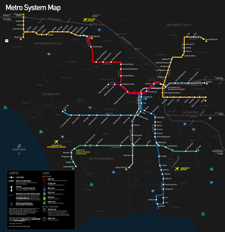
In actual fact, the real gem of the current transit build in Los Angeles (of course, I may be somewhat biased) is the series of LRT lines it’s put down and continues to extend.

Folks. For the record and despite what has been incorrectly stated again and again and again during Toronto’s ongoing, rage-y transit debate for the past 3 years or so, our city doesn’t have any sort of LRT operating within its system. LRTs are not glorified streetcars. The St. Clair disaster was not perpetrated by any sort of LRT. The Spadina bus was not replaced by an LRT.

Los Angeles has LRTs. Toronto does not.

I only had the opportunity during my ever so brief transit foray to take one of the LRT lines, the Gold Line, running from one terminus in downtown’s East LA and the other, up to the north and back east, in Pasadena. goldlineTwo other LRT lines connect to Union Station via subway, one running south down to Long Beach, a second, the Expo line, heads west toward the Pacific, now ending in Culver City but a much needed extension to Santa Monica is slowing inching its way to a 2015/2016 completion date. A 4th light rail line, the very first one built, runs south for about 35 kilometres from downtown-ish to Long Beach, connecting to both the Blue Line LRT and the Silver Line BRT along the way.

You may ask why, if I’m such a big fan of LRTs, I wasn’t all over that map, giving each and every one of those lines a serious test run. Here’s the thing. One, there was only so much time in one day. Secondly, what the LRTs offered to someone such as myself, armed with a $5 day pass and curiosity bordering on obsessiveness, was the ability to hop on and off the train wherever it caught my fancy. With much of it being above ground, you looked out the window and seeing something interesting, off you got.

Which is how we ended up in South Pasadena. Mission Station was situated in what looked to be the main intersection of some quaint little town lifted right out of Frank Capra movie. missionstationSteps off the train, you walked along a street of refurbished buildings now housing bars, coffee and artisanal shops. Or what they used to refer to as Mom & Pops. Huh, I thought. I might’ve missed this had I been travelling underground, heading hell bent to my destination further on.

Of course, transit isn’t built for demanding tourists who want the luxury of sightseeing without the hassle of driving to get there. You build transit in order to efficiently move as many people as possible around a region. Places like Los Angeles have realized relying on the private automobile is not the most effective or healthy way of doing that.

My guide for the day, Ned let’s call him because that’s his name, is a long time Angelino now looking to live a less car-dependent life in LA. 90sWhen we first met, back over 20 years ago, such a thing was nothing but a pipe dream. You don’t want to get around by car in Los Angeles? Move to San Francisco.
Now? Not a pipe dream. It isn’t easy, certainly not everywhere, trying to navigate the city without your own four wheels. Parts of Los Angeles remain severely under-serviced by public transit including the affluent west side where recalcitrance to share the roads (both at grade and below) on the part of municipalities like Beverly Hills have left places like UCLA in Westwood isolated from the rest of the city.

Still, this is not the laughably public transit stunted city I remember. While the state as a hole has suffered severe economic blows over the past decade or so. Los Angeles has managed to fund their public transit renaissance. TOtrafficcongestionFormer mayor Antonio Villaraigosa helped convince a normally tax-averse population to accept a half-cent sales tax increase to fund a 30 year transit expansion. He then took this Measure R to Washington to secure federal loans in order to shrink the 30 year timeline down to the 10. 12 proposed major transit projects in 10 years.

If such a feat can be accomplished in a car-centric city like Los Angeles, what exactly is holding us back here in Toronto?

dutifully submitted by Cityslikr

The President’s Man Goes Local

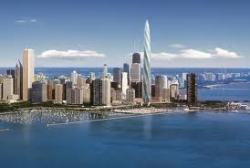
So Rahm Emanuel resigned his post as chief of staff to the most powerful position on the planet (after, that is, the top 5 places within the Chinese government structure) to run for the mayoralty of Chicago. This is a guy who served for three terms in the House of Representatives. He’s now running to be mayor of Chicago. A power broker inside the D.C. Beltway packs it in for what looks to be a rough ride of an election in the 3rd biggest city in America.

Does that strike anyone else as a step down a rung or two of the success ladder?

I mean, aren’t mayor positions simply consolation prizes for those without the goods to make it big at state/province or federal levels of government? It certainly seems to be the case here in Toronto during this particular campaign cycle. Also-rans and not-quite-good-enoughs battle it out for ultimate supremacy of this backwater burg we call home.

Yet, here’s arguably the meanest, nastiest and most successful backroom Democrat in recent memory heading out of Washington to try his luck running for the lowly position of mayor. Obviously it’s some sort of punishment being meted out for the crime of pushing President Obama too far to the middle. Yeah, thanks for all your help, Rahm. How be you just run along now and try your hand at local politics?

Or, maybe this is a case of an extremely motivated politician realizing just which way the wind is blowing, where the action really is. Cities are where it’s at, baby. In this globalized world of increasing urbanization that we’re living in, cities are assuming control of the agenda, the engine driving innovation, sustainability, diversification. What politician with an elevated sense of self-importance (one can posses that trait in a good way) wouldn’t want to be at the forefront of all that?

Gazillionaire Michael Bloomberg, touted as a possible independent candidate to run for the presidency of the United States, takes a pass, opting instead to stay as mayor of New York City. In Los Angeles, Antonio Villaraigosa dabbled for a time in California state politics before moving into the municipal arena, first as a council member and then mayor. Portland Oregon mayor Sam Adams has burst onto the national scene as a leading advocate for building environmentally sound cities. So famous has he become that a beer has been named in his honour.

But over the course of Toronto’s dreary 9 month campaign so far, we’ve been told it’s just about filling potholes and fixing street lights. After 7 years of tentatively stepping toward the future, all we’re hearing now is what we can’t do, not what’s possible. Voters are cowering in the face of necessary and exciting change; their fears and worst instincts catered to by unimaginative candidates who seem oblivious to the shifting sands of where power is headed. We imperil our ability to adapt to what’s coming and thrive in the possibilities that will arise if we hand over the levers of power to someone incapable of seeing past nickels and dimes.

Rahm Emanuel seems to understand this. He’s angling to take the reins of a great but deeply troubled city. Much more troubled than even the worst case scenario being painted about Toronto by the hysterics contending for the mayor’s position. Chicago’s money woes are significantly worse than ours. Allegations of actual corruption and cronyism have stuck to some of the outgoing city officials. Crime is a significant problem there and not just a convenient bogeyman being shaken around in order to frighten voters.

Despite all of that, Rahm Emanuel wants to be the mayor of Chicago. There’s an element of flight, certainly, from an administration looking to take a hit in next month’s midterm elections. If it does happen, there’ll be plenty of fingers pointing at Emanuel as a prime architect of Obama’s fall from grace. But he could run toward a much more lucrative spot in the private sector, assuming such a thing exists anymore which also might explain the President’s low approval ratings.

Emanuel’s decision to follow in the footsteps of Richard M. Daley bespeaks of how important cities have become on the political landscape. Those accepting that new reality have begun to assume responsibility for proper future planning, at times defying upper levels of governments by setting more stringent environmental targets and broadening personal rights and freedoms. In the vacuum created by the divestment of powers by successive federal and provincial/state governments as a way to balance their books, forward thinking cities have assumed the responsibilities and set out on a course to not only remake themselves in a 21st-century fashion but the regions and countries that they are part of as well. Savvy politicians like Rahm Emanuel recognize that and are jumping at the chance to get involved.

It’s unfortunate Toronto has been hijacked by mayoral candidates more content to wallow in petty grievances and almost tribal hostility instead of generating ideas about how best to move into a future where cities will be at the forefront of policy decisions and societal change. If the next mayor doesn’t understand that and seize upon it, all the advantages we as a city have presently (and we have many) will be for naught. Our enviable position cannot be translated into expanded opportunity by merely filling potholes and fixing streetlights. We need to stop shying away from thinking bigger.

civically submitted by Urban Sophisticat

Drive, He Read

To avoid any appearances of a conflict of interest or accusations of log rolling, I have been tapped to write this post today. I am not a reviewer of books. My métier of TV and movies is more passively pleasing to me. But since both Acaphlegmic and Cityslikr are, if not friends, than certainly amiable drinking companions of Tim Falconer, it was felt that perhaps we needed a more objective take on his 2008 book, Drive. My lone encounter with Mr. Falconer was just after he’d had a pedicure and kept demanding to see my feet which didn’t make me partial to liking his book.

Although of all of us who toil away here under the All Fired Up yoke, there’s little question that my voice is loudest when it comes to making anti-car noises. So Drive is really up my gasoline alley, as it were. It’s almost as if Mr. Falconer wrote the book with me in mind. Quite a feat since we had never met during the course of the writing.

But the author and I do share a similar non-car background. He didn’t get his full on, non-learners driver’s licence until his late-30s. I got mine when most red-blooded males did back in the day. At the age of 18 when you needed it as picture ID to get into bars and buy booze in the stores. I’ve not had much use for it since, living as I do, along with Mr. Falconer, in downtown Toronto and its wide range of transportation options. (Note to ed.: I don’t live with Mr. Falconer but rather we both live in downtown Toronto. In completely separate abodes.)

Unfortunately, a few years back Falconer broke down and sold out, buying a 1991 Nissan Maxima despite considering himself first and foremost a pedestrian. In it, he headed off on a 9-and-a-half week, nearly 15,000 K road trip from Toronto to the heart of car culture, Los Angeles, and back again; a journey that is the narrative basis for Drive. Like any good road trip (and I would never claim that there can’t be good road trips), the tale Falconer spins is a meandering affair, never doggedly adhering to a rigid map route. Along the way, we get a thorough history of the automobile and its immense impact on the development of society especially after World War II.

The subtitlely thingie of Drive is “A Road Trip Through Our Complicated Affair With The Automobile” and truer words have never been written after a book’s title. What was most startling to me while reading this book was, for every sane person who either hates cars or doesn’t put much thought at all into their existence, there seems to be a dozen who absolutely love them. I mean, really, really loves them. These self-proclaimed car nuts never outgrow their adolescent fascination with their toys.

If there’s one complaint I had with Drive, it’s that too much time is given over to these car freaks which, to my deaf ear on the subject, began to sound all the same. After yet another outing Falconer takes with the Rocky Mountain Mustangers or Gateway Camaro Club, I found myself growing increasingly irate and finally snapping. I KNOW HOW MUCH YOUR CARS MEAN TO YOU, PEOPLE! BUT THEY’RE JUST THAT! CARS! I COULDN’T GET ENOUGH OF CRACK COCAINE EITHER. I JUST HAD TO STOP DOING IT FOR THE SAKE OF EVERYONE AROUND ME!! YOU SHOULD TOO!!!

The beauty of Drive is that it seems to anticipate that reaction in many readers and delights in turning the tables on them… er, me. It’s not surprising that I reacted so violently negative to yet another pot-bellied, middle-aged car jockey waxing nostalgic about his Ford Falcon because early on in the book, Falconer provides data that shows Canadians are more prone to see their cars as little more than appliances to be used in getting to where they need to go. Americans revere their cars and treat them accordingly as potent symbols of freedom and mobility. So naturally, I’m going to see them as completely out of touch with reality and vile, brainless materialists. Thus, Falconer deftly manages to shine a glaring light on my prejudices.

That makes the real heroes of the book the ones Falconer meets who have a much more rational approach to the car conundrum than I do. Hell, some of them even like driving but have concluded that urban planning around the needs of cars is the surest way to inflict the greatest amount of damage on cities.  There’s James Kushner, a teacher at Southwestern Law School in Los Angeles and perhaps the only Angelino who does not own a car. His two books, The Post-Automobile City and Healthy Cities are in the mail as I write, destined to the growing pile of books I need to get to in order to truly start understanding urban dynamics. Donald Shoup, ‘America’s Parking Guru’ (and who we featured here back in March. You may recognize my colleague’s dining and discussing partner) is a joy to listen talk so academically about the problems of parking and how to fix it. (Heads-up: we aren’t paying nearly enough for it.) His book, The High Cost of Free Parking is already on my book shelf.

But the nucleus of the post-automobile future city truly emerges in the last 8 pages of Chapter 16 (San Francisco, Man versus the Internal Combustion Engine). Mr. Falconer talks with two members of the Sierra Club. John Holtzclaw chairs the organization’s Transportation Committee and Tim Frank is the chair of the group’s Challenge to Sprawl Campaign Committee. Together they put together an urban environment where private vehicles will slowly and naturally be squeezed out or, at the very least, be severely reduced in importance. How will this come about? Our growing urbanization and need for higher density. (A ‘variety of densities’, according to Holtzman.)

Presently, density is a hot button issue but those resisting it appear to be on the wrong side. Frank argues that density could, ironically, wind up uniting right and left. He sees density appealing to the left because of its tendency toward social justice if things like mixed income housing are part of the plan. The right will take to it as denser communities make various government services less expensive to deliver and need fewer people to deliver them. Increased density equals smaller, more efficient government.

More exciting still for those of my political stripe, John Holtzclaw believes that increased density creates a more tolerant, liberal-minded society. “People who live closer together and are less dependent on the automobile develop a different attitude toward citizenship and activism,” concludes Falconer. So take heart, all you who grow dismayed in the face of Rob Ford’s spike in popularity and Stephen Harper’s relentless push to neo-con Canada, for they are fighting a losing battle. The slow march of history is on our side.

How cool is that? A political manifesto rising up from a book about cars. That’s quite something to pull off but is exactly what Tim Falconer does in Drive. So run, don’t walk (and certainly don’t drive although cycling is encouraged) and pick up your copy. The revolution (or – a-ha, a-ha — the rpms) has begun.

car-freely submitted by Urban Sophisticat