The Bold And The Beautiful

It’s difficult to reconcile being in a room full of articulate, passionate and fully engaged Torontonians for about 6 hours or so and the state this city finds itself in currently. I mean, if we’re facing such seemingly intractable and menacing issues, why aren’t some of these people in charge? After all, they can’t be that busy. Here they were, taking an afternoon to talk to the likes of us.
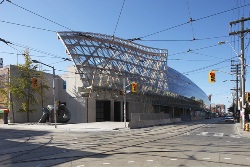
So it was yesterday as I sat in attendance in the Baillie Court auditorium at the AGO for a symposium, Imagine Toronto, that kicked off the launch of The Toronto Project followed by a Walrus sponsored debate, Be It Resolved That Toronto Will Never Be Beautiful. The room was packed with bright stars both on and off the stage, exchanging ideas, expressing hope (guarded), concern (sincere), outrage (very, very palpable). David Crombie moderated the afternoon session that featured 10 takes on the essence of Toronto, past, present and future. There was author-professor-philosopher Mark Kingwell. From the Maytree Foundation, Ratna Omidvar. Author-editor-stroller, Shawn Micallef. CivicAction‘s Naki Osutei. Rahul Bhardwaj talked about Toronto’s worrisome Vital Signs but remained surprisingly upbeat. Architect Wayne Kuwabara. Visual artist Shary Boyle tore up the place, beseeching the audience to imagine a Toronto that embraced itself and its artists proudly rather than half-heartedly. Writer-activist Dave Meslin called for more community, grassroots engagement in our political process.

That was all before the evening’s entertainment had begun.

One crossover between the day’s two meeting of minds was journalist John Lorinc. His cover article for the November issue of The Walrus magazine, Where Toronto Went Wrong, has been the talk of the town since it came out and was the cornerstone of both gatherings. No, folks. Things didn’t suddenly go south when Rob Ford became mayor. Even the enforced amalgamation foisted upon us by the Harris government and the subsequent downloading and bailing of responsibilities by Queen’s Park cannot be pointed to as the only culprit although it certainly served as a key role in how things are playing out here presently. Weaving a historical overview, Lorinc writes about how for every positive step the city leaders and their provincial overlords took, such as the creation of a two-tier system of regional governance with the formation of Metropolitan Toronto in 1954, there were two steps back like, well, the undoing of Metropolitan Toronto in 1998. (Amalgamation didn’t have to include the elimination of the metro level of government.)

My take on the whys and hows Toronto ‘lost its groove’ can be distilled in two points Mr. Lorinc makes in his article.  “Unfortunately, Toronto’s history is filled with examples of high-minded plans for open spaces that were crushed by its deep-seated disinclination to invest in the public realm.” Four paragraphs later he writes, “Such not-so-benign neglect, borne of a culture of stinginess, has been a long-standing element of Toronto’s DNA.”

Our leaders have suffered from a severe aversion to boldness, masked in an embrace of parsimoniousness calling itself fiscal prudence. Not only have we allowed them to conduct their business in such a fashion, we’ve encouraged it, demanding low taxes before civic amenities. ‘Need-to-haves’ over ‘nice-to-haves’ to use Mayor Ford’s words.

A ‘stinginess’ with money infecting a ‘stinginess’ of spirit. No to a Yonge Street subway in 1912 because of its price tag, repeated some 80 years later when Mike Harris buried the hole already dug for an Eglinton Avenue subway. The costs too rich for our blood that would haunt and saddle future generations with a significantly higher amount of money needed to think big on matters of transit. A history of here and now closed-mindedness and fistedness.

Remember a few months back when Councillor David Shiner killed plans for the Fort York bridge because he thought it ‘too fancy’? A miserliness of thinking handed down from his mother, Esther Shiner, Spadiner Shiner, who led the charge to extend the Spadina Expressway from where it had been stopped in its tracks at Lawrence Avenue down to Eglinton Avenue. The so-called Davis Ditch which, among other proposals was one from Buckminster Fuller that feature a mixed use development atop the Spadina subway extension. Instead, we got Allen Road. Anyone who’s ever tried to negotiate that intersection on foot, bike or even a car knows the price we paid for that.

We have inherited a short-sightedness in terms of money that never seems capable of taking in the bigger picture. A deficit of boldness that always means passing the buck, both literally and figuratively. Sometimes, oftentimes, a penny saved is not a penny earned. It’s just responsibility deferred.

To be bold means more than strictly adhering to the bottom line. Down the road, money you think you’ve saved just accrues, collecting interest that will have to be paid by someone else. Not doing something because it seems unaffordable now may seem noble and conscientious and shows Respect For The Taxpayer but in many cases, when it comes to building a sustainable, liveable, just city, is nothing more than a refusal to govern. It isn’t even caretaking. It’s obstructionism. Politicians priding themselves in that would do us all a favour and step out of the way. As I witnessed yesterday, there’s plenty of people ready to offer up solutions and ideas to get Toronto back on the right track.

hopefully submitted by Cityslikr

Waterfront Waterloo

It’s far too early to write off the Ford administration. So early that I really, really wanted to write, It’s way too early to write off the Ford administration. But I really, really detest that adverbial use of the word. You sound like a teenager. Or sportscaster.

More formally, reports of the Ford administration’s death are greatly exaggerated. Premature ejection from the seat of power. I think what we’re witnessing is a wheel coming off their ride, maybe two. It’s broken, just not beyond repair.

For the first time probably since Rob Ford announced his intentions to run for mayor back in March of 2010, he has lost his ironclad grip on the narrative. Reality is no longer bending to his will. Facts pile up, making it increasingly difficult for Team Ford to frame the debate to their advantage. The story they’ve spun to great success so far is crumbling, the scaffolding upon which it was built, too flimsy to bear the weight. Thin air and pixie dust prove to be fickle, unstable elements.

This often times happens when a protest movement assumes the reins of power. As anyone who’s ever taken an improv class knows, the easier option is always to say no. It also leads to the least interesting outcome.

A protest movement coalescing around a faulty premise is especially prone to an early flame-out. The mayor campaigned against out of control spending, waste and gravy. Turns out he may’ve been exaggerating just a smidge. Even outside consultants, KPMG, couldn’t uncover much of the stuff. Certainly nowhere near the amount the mayor removed from the city’s revenue stream by axing the VRT and freezing property taxes.

So cuts became efficiencies became nice to haves. The plain speakin’, tells it like it is, looking out for the little guy persona that the mayor had expertly cultivated begins to lose its populist sheen. The more he tries to plug the holes in his story, the more he starts to sound like a seasoned insider. Macbeth like, he’s now knee deep in the blood from the corpses of lies he’s had to kill in a vain attempt to stop them from turning on him.

Oddly, it’s the waterfront, an issue the mayor barely expressed any interest in while campaigning that seems to have caught him most effectively with a shot to the chin. Perhaps he and his brother made their move too soon when Doug started calling Waterfront Toronto unflattering names back in the spring. It left ample time and space for its advocates and defenders to mount their defense. And these weren’t the usual suspects that Team Ford could easily dismiss. The downtown elite. The left wing kooks and unionists. The statistically invalid.

No, these were players. Urban planners. Respected academics. Richard Florida is set to break his silence about governance in his adopted home town in defence of Waterfront Toronto. David Crombie. David Fucking Crombie.

So strong has the pushback been, the barricades so robustly manned, that once mute and pliable allies are now emerging from their hovels to speak out against the mayor’s plan. Councillor Peter Milczyn did so meekly, referring to the Ford waterfront idea as ‘a visionary exercise’ that, unfortunately, ‘blew up in our faces’. Councillor Jaye Robinson was much more forceful, stating outright her confidence in Waterfront Toronto and that she would not be supporting the mayor when this item goes to council next week for a vote.

A close vote, Councillor Robinson predicts, but frankly, I don’t think it’s going to come to that. This is not the hill Mayor Ford is willing to die on nor will he want to see his brother hung out to dry on a losing end of an issue he was so front-and-centre on. No, before council gets to knock this one out of the park, it will be amended to the point of meaninglessness, tossed under the bus of further staff review and committee study where it will die a quiet, unnoticed death.

The mayor has bigger fish to fry and is now stepping into the fall of our growing discontent, the haunting spectre of budget battles looming, weakened by a terrible, terrible summer. But it is early still. Much political capital has been expended yet the mayor has powerful tools at his disposal. In fact, if he plays this right and can back off gracefully, be seen to concede and bow to the will of public support, it could ultimately help him continue to push his agenda through. See? I listened. I made concessions. I’m a reasonable guy. I can play along nicely with others. What are you going to do for me now?

It could happen although that doesn’t seem to be part of the mayor’s constitution, to admit he was wrong and to backtrack. Instead he will probably attempt to change the channel, lumber forward having learned almost nothing from this set back. This administration does not blink, we’ve been warned.

What the mayor’s opponents need to take away from this show of democratic muscle is that it’s not simply enough to stand up to the mayor and say no. There needs to be a plan in place to counter each and every one of his ill-advised proposals. Power, like nature, abhors a vacuum. Mayor Ford has succeeded in sucking all the air out of the room. It is now a race to fill it back up again. By virtue of the powers of his office, the mayor still has a leg up against his competition. The self-inflicted wound he’s just administered, though, has hobbled him and added a new bounce into his challengers’ step.

elbaly submitted by Cityslikr

Ferris Wheel Of Fortune

(Repurposing of our Wednesday post over at Torontoist, with bad grammar and possibly poor spelling reinserted from an earlier draft.)

* * *

As the battle begins over a new vision for Toronto’s waterfront, the Fort Sumter shot fired by Councilllor Doug Ford’s commercial heavy, where’s everybody going to shop by the lake dream, what it all comes down to is a fight over the public realm. The Ford’s have no taste for such a thing, might not even understand what it means. Those who have been in on the process since Waterfront Toronto’s inception more than a decade ago believe it should be the driving force behind the development.

Invest in the public realm, and private investment is sure to follow. That’s the view of former Toronto chief planner Paul Bedford. Meanwhile, if you put the private sector before the public realm, you get Queen’s Quay. Now adjunct professor of city planning at the University of Toronto and Ryerson University, and senior associate at the Canadian Urban Institute, Bedford came to City Hall yesterday to speak before council’s Executive Committee, which was meeting to discuss the mayor’s new plan for the Port Lands.

This idea, of investment in the public realm coming first, lies at the centre of the current flood control plan. (The Port Lands surround the mouth of the Don River, which like all rivers can sometimes overflow its banks. Flood protection measures must be implemented before any building on the surrounding land can occur.) Team Ford says that there’s no money in place to fund it. Ipso facto, they go on, let’s hit up the private sector– their go-to answer for almost everything. In return for a sweetheart deal on any nearby land, said private sector would, maintain the Fords, happily build the needed infrastructure. Just like they’re lining up to do for the Sheppard subway line. (Cough, cough. Cough, cough.)

Conversely, those who favour investment in the public realm before selling to developers argue that if the public sector builds the flood control infrastructure, the nearby land will increase greatly in value, and the City won’t have to unload properties at a cut rate price. This means more money flowing into government coffers to help offset infrastructure costs. (This is the exact opposite of the argument the Ford administration made about their proposed Sheppard subway line. Of course, they are now having to go to the province, cap in hand, to ask for some seed money to get things rolling. Cough, cough. Cough, cough.)

Never mind the fact that some might argue that it’s the role of government to build infrastructure and not to leave such a vital component for a healthy society to the vagaries of the market place. Some might argue. Unless, like the Fords and their neo-con herd of sheep on the Executive Committee, you believe the less a role government plays, the better. End stop.

Mayoral brother Doug Ford’s disregard of the public realm is such that he couldn’t be bothered to stick around after the entirely predictable Power Point (and not at all jaw-dropping) presentation of this new proposal and defend his vision to just one or two of the 30 or so deputants who were there to stand up for the current plan. Instead he took to the friendlier environs of a media interview/infomercial to take on “ferris wheel hypocrites.” (You heard it here first, folks.) This allowed the councillor to get out ahead of the sense of dismay and alarm that was building amongst the deputants and crowd at his half-baked, half-cocked waterfront plan in Committee Room 1.

Whatever it is going on in their noggins seems to be completely contrary to the actual facts on the ground. If Tuesday’s Executive Committee meeting showed us anything, it’s that whoever is behind this move to blow up ten years of planning and replace it with something slapped together under the cover of darkness has no idea what is actually going on on our waterfront. Or if they do, they don’t want their supporters who they’ll need to push this thing through council to know.

They tell us that nothing’s going on down there. (There is.) They claim that the whole entirety of Waterfront Toronto is the biggest boondoggle they’ve ever seen. (It isn’t. In fact, it isn’t a boondoggle at all. Don’t believe me? Ask a real life, honest to God conservative, former mayor David Crombie. Or even a less than honest to God conservative, federal finance minister, Jim Flaherty.) They say the cupboard’s bare and there’s no money anywhere to proceed any further. (Wrong, wrong, wrong.) All of it wrong.

It’s almost as if they can’t stand to see government in action actually succeed. To have to admit that a slow, deliberate, inclusive, democratic process is able to create something special that this city can truly be proud of. That the so-called public realm not only needs to be nourished but if it isn’t, everything else becomes simply a crass, sterile money grab.

Yesterday’s Executive Committee meeting did not show us two competing waterfront visions. What it revealed was two competing visions of urban planning. One, which deputant after deputant advocated for and defended, is a strong, vibrant public realm as the basis for strong, vibrant communities, neighbourhoods and cities. A fundamental belief that planning must involve engaging the wider community at every step of the process just as Waterfront Toronto has done. The dreary, time consuming aspect of public consultation that gives the appearance of `nothing being done’ to those who hold citizens’ views as little more than an afterthought. Those who see planning as nothing more than grand announcements with little substance and much ad hockery. A desiccated public realm, picked clean and sucked dry by those needing and looking for a quick buck.

It’s city building versus city exploiting. The first isn’t always pretty but the second masks its ugliness behind bright lights and shiny baubles until it’s too late for us to get a good look at it.

repeatedly submitted by Cityslikr