Resist. Reclaim. Recreate.

Resist. Reclaim. Recreate.

Resist austerity. Reclaim the economy. Recreate democracy.
A slogan making the rounds through the Occupy movement south of the border. And one, arguably and unfortunately, that has not made its presence felt here in Toronto. That is for another post but as this city lurches toward the 2012 budget debates it is something to keep in mind.

Resist austerity.

We are being told, hectored actually, in Chicken Little toned language that Toronto is facing a dire, apocalyptic fiscal situation. A mess inherited from years of profligate, wasteful spending. Austerity is not desirable. It’s just necessary. Our hands are tied. We have no choice, folks.

Wrong. Wrong, wrong, wrong.

Fact: the coming year’s “opening pressure” or “budgetary shortfall” of $774 million dollars is just under $100 million more than the average opening pressure of $677 million over the course of the last 5 years. In fact, according to the city’s own reckoning way back in February (pg. 64), the opening pressure could well be some $244 million lower. $530 million which would be significantly smaller than any budgetary shortfall we’ve faced in the last 5 years, nearly $144 million less.

Yet the mayor and his budget chief continue to tout the $774 million figure. Bigger is better. Bigger is scarier. Bigger means more drastic action must be taken.

Resist austerity.

Whatever the number is, whatever the opening pressure or budgetary shortfall turns out to be, what it isn’t is a deficit.

Fact: this number just did not spring up from miscalculation and misspending. It is an estimate, an overly cautious estimate at that, based only on an educated guess at the upcoming year’s expenditures versus the current year’s revenues. How cautious is this overall estimate? It uses expected spending increases while ignoring assumed bumps in revenues. Our opening budget pressure emphasizes cost increases without taking into consideration any boost in money coming into the city coffers. So the budgetary shortfall always skews toward the absolute worst case scenario.

Why? Well, the one thing that municipal governments cannot do, what the other levels of government can, is to run an annual operating budget deficit. So it would be lunacy to make rosy predictions about your financial picture only to find yourself facing an actual short fall come year’s end. A city would be defying provincial legislation if it did. Better to begin with the grimmest of budget scenarios, pencil in 3 massive winter blizzards into the snow clearing budget and when they don’t happen, Bob’s yer uncle. “Found” money.
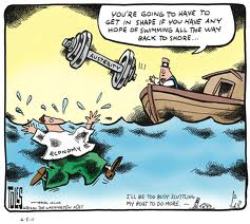
Ignore the zealot, wailing and with gnashing of teeth, telling tales of unmanageable numbers. The amount is artificially large and under constant downward revision. For those with the best of intentions, it is for the purposes of balancing our books. It is the charlatans looking to exploit what is merely a book keeping exercise so that they can carry out the plans they had all along. An out and out attack on the government they were elected to serve and gut the services it is their job to provide.

Resist austerity.

Fact: anyone telling you that there is no option, that we have no choice but to institute a regimen of severe cutbacks and pleasantly euphemistic ‘belt tightening’ is engaging in straight up scaremongering as a cover for their ulterior motives. That, or they simply don’t understand the budget process. Either explanation should be fundamentally unsettling to the citizens of Toronto. The budgetary ship of state is being helmed by those purposefully looking to sail it right into the rocks or they are simply unfit to be in charge of something as big and complex as this city.

How else can to explain the decision they made last year to deprive the city of a necessary revenue stream? Two, in fact, when they jettisoned the vehicle registration tax and froze property taxes. Both to the tune of some $132 million. That amount alone would’ve reduced the early opening pressure of $774 million down to $646 million, some $31 million less than the average shortfall since 2007.

Rather than working to solve the so-called fiscal crisis, this administration has actively managed to contribute to it. Almost as if they’ve intentionally sought to tie their own hands, limit the options, in order to enact the slashing and burning that’s been their goal from the very start. Sorry, folks. We have no choice. This is the hand that’s been dealt us. My heart bleeds for all those affected but, you know, at the end of the day…

Resist the lure of the inevitable. Our hands aren’t tied. There are plenty of options. Nothing is set in stone.

Or as Sheila Block at the Wellesley Institute calmly inform us in their Countdown to Zero: Balancing Toronto’s Budget:

Toronto city council will be making decisions over the next few weeks that will have an impact on our city’s future. These decisions will have an impact on our economic future, on the kind of city we live in and on the health of all Toronto residents. As this report makes clear, the City of Toronto is not in a severe financial crisis and without options, as the rhetoric coming from the mayor’s office would have us believe. Rather, city council has real choices before it. It can make choices that will support a city building budget: one that builds a more equitable, more prosperous and healthier city for us all. Or, it can make choices that will diminish the city and those who live in it.

Resist austerity.

— irresistibly submitted by Cityslikr
Beware The Man Bearing Bad Analogies

While we’re on the subject of specious budget debate claims… and as a matter of fact, we were. Just yesterday. What do you mean, you weren’t following along. I’m not in this to hear myself write, folks. What I’m doing I do for you. So please, if you wouldn’t mind…

Last week, the Toronto Star’s Royson James penned a little ditty about the boneheadedness of contemplating selling off a 10% piece of the Toronto Hydro pie. I’ll let him do the explaining his reasons in the article but something that caught my attention was a quote from the deputy mayor, ol’ trusty for a crazy quote, Councillor Doug Holyday. “If you’re going to lose your house, you have to sell your cottage.”

Ohhh, how I love tattered and broken down analogies that sound so full of homey wisdom and common sensical matter-of-factness at first blush yet disintegrate like old school vampires when a ray of reasoned sunlight shines upon them. Governments need to balance their books just like every household does. You see, taxes are like revenue, like when you get paid for a service you provide. Expenditures are like, well, expenditures. What you pay out for a service which has been provided to you. At the end of the month, these revenues must match expenditures, otherwise—

Zzzzzzzzzzzzzzzzzzz.

Right wing, neoconservative, small government types who populate Mayor Ford’s administration love this trope. It’s so easy to understand. It’s the very definition of straight forward simplicity which should be the first sign that it’s also fundamentally, categorically wrong.

In June, over at Ford For Toronto, Matt Elliott took Budget Chief Del Grande to task for spouting similarly inane platitudes. “We are no different than any family in Toronto who spends more than we earn,” the budget chief told the National Post. “We need to get a second job. We would love to send our kids to camp, but it may not be the most nice camp. Or maybe the kids don’t go to camp at all.”

See, at a budgetary level, government is most definitely different from a family. A family is finite, let’s call it. Its budget plan must include a point of time in the distant future when the main revenue source dwindles. Known as retirement. Hopefully, there’s been enough savings done to bridge the gap between then and when the sweet embrace of death comes.

Governments, on the other hand, aren’t as terminal if one’s lucky enough to live in a relatively stable democratic tradition. Revenue and expenditure ebbs and flows but doesn’t end when one government is ‘retired’ through, say, electoral misfortune. So government budgeting is, in fact, quite different from household budgeting.

But even that comparison is superficial and not complete. As Mr. Elliott suggested, these analogies often only go part of the way. Budget Chief Del Grande suggests the city needs ‘to get a second job’. To which Elliott responds, “But last year the city did have a part-time job. It paid more than $60 million per year. [The VRT if you’re having trouble following along.] The city quit that job.”

The same line of reasoning goes with the deputy mayor’s selling the cottage analogy. What if the cottage is a revenue generating rental property? Instead of selling it off, you decide not to spend the summer at it and rent it out. The money you make can then be ploughed back into the payments you need in order to save the house.

Only if you were in absolutely desperate straits, and needed cash money right now to stave off foreclosure would you sell the cottage. Which is what Team Ford wants us to believe is the state of affairs in Toronto currently. There’s also a hint of entitlement, privilege and living beyond your means in the cottage reference. Bit off a little more than you could chew, irresponsible homeowner? Maybe you’re not up to owning two properties. You should try summer camp for the kids. But not too nice a summer camp, mind.

They hide behind these tired analogies to mask their real intentions. To sell off the city piece by piece and cut the government down to a more fitting size. Nothing more than keeping the streets clean and safe. Anything beyond that is simply gravy, an unaffordable second home that is well beyond our means.

It shifts responsibility from small-minded, self-serving meagreness of spirit onto supposed profligacy. Tough medicine meted out by sober, mature adults after a wild party thrown by teenagers. A claim that is so shop worn that it sullies the word ‘cliché’. It needs to be ignored at all costs.

— tired and hackneyedly submitted by Cityslikr

Stuck In The Middle With Josh

As even the most casual reader (and we really do insist no ties or business pants suits be worn while reading here) of this site will know, we here at All Fired Up in the Big Smoke aren’t Mayor Ford’s biggest fans. There’s a political and social gulf between us. I know who Mary Walsh is. He doesn’t.  He thinks you can gut a city back to health. I don’t.

But while we fret about the very real possibility of the mayor and his team burning down the place in their misguided attempt to fix it, we also secretly harbour a sense of satisfaction that the more matches they light, the more they discredit and undercut their extreme small government, radical neoconservative ideology. Shhh. Don’t tell anyone. We might come across as a little two-faced.

Speaking of two-faced and the awkward segues that spring from such clumsy transitions, there is an equally insidious force at work at City Hall. One just as destructive as the mayor’s hatchet and chainsaw and perhaps even more dangerous. It enables the dismantling under the guise of bipartisanship. It puts a smiley face emoticon on the snarl of right wing nastiness.  It has a name: faux-centrism. Its face? Councillor Josh Matlow.

We have written indignantly about this previously (for example, here and here) but it all got stuck in my craw again when I stumbled across this little puff piece, “Newbie councillor trying to rise above it all”, in My Toronto Today.ca. Note the accompanying picture, a non-buttoned down Matlow, standing in the long grass of City Hall’s green roof. It’s just one Nehru jacket away from looking like the cover of a 1970s album.

I found the article particularly grating having watched him at work during this week’s council meeting especially during the debate over contracting out waste collection west of Yonge Street. Councillor Matlow voted in favour. No biggie. So did 24 other councillors. But his reason for doing so were all, pure Matlovian.

He questioned staff about the, well, questionable numbers, the dubious claims to enormous savings. He rooted his snout through the dirt like a pig hunting for truffles, desperately searching for the elusive middle. They’re saying one thing but they’re saying another. The truth must be somewhere in between.

(No, no. Again, councillor. If one side touts debatable numbers and the other side puts up a more realistic set of numbers, the truth isn’t lurking near some imagined mid-point. Allow me this analogy. I go to the fair and decide to give the Guess My Weight guy a whirl. He thinks I come in at 185 pounds – it’s an American touring show, they don’t know from metric. I say, not even close. I’m 155 pounds soaking wet. Using your method, that probably means I’m about 170 pounds, right smack dab in the middle. But I step on the scale and reveal myself to actually be 225 pounds, winning a stuffed animal because the guessing guy was more than 5 pounds off but it in no way means that I weigh 170 pounds.)

After the usual huffing and puffing about the loneliness of the moderate voice these days at City Hall, Councillor Matlow casts his vote in favour of the mayor’s demand to contract out collection. Why? It’s a beaut. The councillor isn’t at all sure about the savings for taxpayers or if the low bid company GFL is even up to the task but still, still, people remain angry about the strike back in 2009. We have to cater to that anger or risk generating even angrier voters. By exercising the democratic right to strike, the city union put poor Councillor Josh Matlow on the spot and he just had to vote to contract out their jobs.

And he’s at it again in the My Toronto Today article, shifting blame onto someone else for his decision to vote in favour of getting rid of the revenue generating Vehicle Registration Tax. “I think it was done too hastily,” Matlow said. “I believe there should have been a stronger argument from the city manager as to how it would impact the 2012 budget.” I was just brand new. How was I supposed to figure out that taking millions and millions of dollars from the city’s coffers was going to adversely affect future budgets? I wasn’t aware that basic math applied to City Hall.

“Though he’s been vocal in his questioning of Ford’s leadership, Matlow says he agrees with many of the mayor’s initiatives, including a review of Toronto services.”

“What I strongly disagree with is the method he’s gone about implementing those ideas,” he said. “I would have liked to see a more thoughtful and mature process.”

But to the mind of Councillor Josh Matlow, Mayor Ford isn’t entirely to blame for this. And certainly the newbie councillor isn’t either. You want to know whose fault it is? David Miller’s, that’s who.

“The biggest surprise for me is how much influence the mayor’s office has over the agenda at city hall,” Matlow says. “And it’s ironic that it’s the left-wing and the Millerites themselves that created the stronger mayor system that they’re now subject to.

“Ford has taken advantage of the very house that Miller built.”

You see, none of the current divisions running rampant through City Hall, none of the bad decisions that get made are Councillor Matlow’s fault. He’s a centrist, after all. The rarest of rare birds. A condor of consensus. An ivory-billed woodpecker of moderation. He’s not on the mayor’s team. He’s not on the opposition left’s team. He’s a free agent, available to either side when the time is right and the situation is favourable.

For Councillor Matlow, there’s no ‘I’ in team but there’s certainly one almost smack dab in the middle of expediency.

— divisively submitted by Cityslikr