An Off-Kilter Moral Centre

[We interrupt our regularly scheduled flow of municipal news, information and opinion to give way to our wayward colleague, Acaphlegmic – back from hinterlands unknown – and his thoughts on yesterday’s death of Senator George McGovern.]

*  *  *

If you’re reading this there’s a very good chance that I am much older than you are. The news of George McGovern’s passing, in likelihood, had the same impact on you as being told a distant great-great something or other had died peacefully in their sleep. A compassionate shrug and I’m sorry for your loss. This does not make you a bad person. Only a young one.

But if you find yourself these days disturbed, dismayed, disappointment at the far right drift of our society, the cult of hyper-individualism, the deification of greed as sound economic policy, wars without end waged against vague concepts, you, my friends, are all children of George McGovern.

It can be argued that his landslide loss to Richard Nixon in the 1972 American presidential election was the official death of the 1960s (although I would mark the occasion 4 years earlier and the assassination of Robert Kennedy). Dirty hippism was soundly relegated to the fringe sidelines; pet projects and peeves of hapless Marxists, jobless malcontents, the socially and sexually deviant. The counterculture was out. Reactionism was all the rage.

We are all Nixonians now.

(And let’s not take comfort in the naïve notion that the likes of Richard Nixon or Ronald Reagan would be too liberal for the Republican Party these days. Both would’ve changed their skins to suit their political needs. They were as conservative as they needed to be and are the progenitor’s of our age’s radical right chic.)

By voting so overwhelmingly for Nixon in ’72, Americans signalled to politicians that appealing to our worst instincts, dividing rather than uniting, operating under craven cynicism and not any sort of honourable principles would be the surest way to winning elections. From that point forward, no decent candidate would get anywhere near the White House. Jimmy Carter was merely a blip on the screen, an electoral eeek! at the revealed hideousness of the Nixon administration, a collective statement that we may be bad but not that bad. Four years later, Americans shrugged and proceeded down the low road.

Now hold on a minute, I hear you saying. No decent candidate? What about Bill Clinton? What about Barack Obama?

Read the following passage from the New York Times OpEd on McGovern and imagine either of them taking such a stand in terms of the country’s foreign ‘entanglements’ in Afghanistan, Iraq.

Yet unlike most presidential candidates since 1972, Mr. McGovern had a moral streak that he refused to suppress regardless of the cost to his ambition. During a remarkable campaign speech at fundamentalist Wheaton College in Illinois, Mr. McGovern called upon his audience to grieve not only for American casualties in Vietnam but also for the Vietnamese lives lost from American military actions. Indifference to Vietnamese deaths troubled him, so he insisted that Americans confront their own responsibility for the consequences of war and “change those things in our character which turned us astray, away from the truth that the people of Vietnam are, like us, children of God.” Words like these led critics to castigate Mr. McGovern as a moralistic scold who was angry at his own country.

‘A moralistic scold’. An apologist. Forty years after that election and it is still considered fringe or radical to question the actions of your country and leaders. America, Love It Or Leave remains the norm.

And look not southward so condescendingly, Canada. Our governments can hardly be viewed as paradigms of good democracy at the moment. Don’t believe me? Even Mr. Andrew Coyne righteously and rightfully has his knickers in a twist.

Now, the strength of many 1960s causes has resisted crippling pushbacks. Women’s rights, gay rights, visible minority rights – equality and inclusion in a word or two – continue their inevitable march toward wholesale acceptance. Not unscathed or free of the relentless and mindless attacks from the right thinkers who remain doggedly in our midst. Still, it would be too overly pessimistic and entirely incorrect to conclude that George McGovern and politicians of his ilk ultimately died in vain.

But we are less of and a smaller society because the likes of George McGovern were pushed aside and thought of as being too out of touch with the mainstream, a far left extremism. By demonizing basic common decency and morality as fringe traits, nice to haves not need to haves, we normalized radical, anti-social political thought. Liberals began to quake in their boots at the prospect of being labelled as such. Tories took flight. True and destructive radicalism from the right assumed the pole position in the race that is now winner-take-all.

sadly submitted by Acaphlegmic

Conservatives Versus Cities

It will come as no surprise to anyone who’s paid so much as even a passing notice of Toronto that we’re presently groaning under the weight of a downtown-suburban political divide. The entirely predictable result of an amalgamated mash-up done at the hands of a disinterested provincial government that possessed an animosity toward the city it was largely unrepresented in. At war with itself so as not to be bother to anyone else.

While it may be an extreme case what we’re experiencing at the moment, I do think it’s indicative of a wider, fundamental phenomenon cities are enduring here in North America. Conservatives, as they have been hard-wired for a few decades now, simply don’t understand and actively distrust cities, especially those parts of a city with fewer detached house than not and higher reliance on public transit to get around. It’s almost a foreign land to most conservatives who run such places like absentee landlords.

Insert ‘Conservatives’ every time you read ‘Republicans’ and ‘Tim Hudak’ or ‘Rob/Doug Ford’ for any Republican politician in these paragraphs from Kevin Baker’s New York Times Sunday Review piece from a couple weeks back, How the G.O.P. Became the Anti-Urban Party.

For Republicans, cities now became object lessons on the shortcomings of activist government and the welfare state — sinkholes of crime and social dysfunction, where Ronald Reagan’s “welfare queens” cavorted in their Cadillacs. The very idea of the city seemed to be a thing of the past, an archaic concept — so much so that Gerald R. Ford seriously considered letting New York go bankrupt in 1975…

Yet the national Republican Party still can’t get seem to get past its animus toward the very idea of urban life. The only place that Amtrak turns a profit is the Northeast corridor — yet all Republicans can think to do is privatize it, along with the local rail lines on which millions of Americans have been commuting into cities to work for as long as a century and a half. Republicans promise to ban same-sex marriage, make it easier for anyone to get a gun, delegitimize and destroy what they mockingly call “public employees’ unions,” and deport the immigrant workers performing so many thankless but vital tasks.

In short, they promise to rip and tear at the immensely complex fabric of city life while sneering at the entire “urban vision of dense housing and government transit.” There is a terrible arrogance here that has ramifications well beyond the Republicans’ electoral prospects.

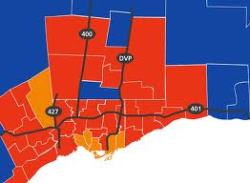
Check out recent electoral maps in Canada. Federally, outside of Alberta, many of the country’s biggest cities are islands of red and orange surrounded by a sea of blue. In Quebec in 2011, it was essentially an orange wave.

In Ontario, provincial Tory blue can barely be seen in any of the major cities. Despite the fact Ford Nation failed to deliver the Progressive Conservatives a single seat in the 416 area code in last October’s election, Tim Hudak is doubling down in support of the mayor’s errant subways, subways, subways plan. He doesn’t seem to get that they don’t seem to get how the city functions, what its needs are.

Take for example Mayor Ford’s campaign promise to cut the number of city councillors in half, from 44 to 22 which would match the number of federal and provincial seats in the city. Why do we need 44 councillors when we have just 22 MPs and 22 MPPs, he’s asked rhetorically on numerous occasions. We don’t, is his answer, revealing a stunning and depressing lack of understanding about the differences in the job description between municipal politicians and their counterparts at the other two levels of government.

The municipalities are where the boots are on the ground, where the rubber hits the road. Councillors are the ones who deal with the day-to-day exigencies of residents. Not just the things that are under direct control of the city but the fallout from both federal and provincial legislation and regulation. Ottawa decides to cut funding for refugees, say. Who picks up the slack?

As Daniel Dale wrote in the Toronto Star yesterday, “A $21 million provincial cut to homelessness prevention funding in Toronto will make it harder for thousands of poor residents to stay out of shelters…” Queen’s Park cuts. Toronto is expected to clean the mess. Quoting Michael Shapcott, director of housing and innovation for the Wellesley Institute, Dale writes, “Unanticipated needs may well arise and then the city has to make one of two hard choices: pony up local property-tax dollars, which are of course already scarce and fully allocated elsewhere, or secondly, say to people, ‘Tough luck, can’t do anything, you’re on your own.’”

Cities deliver the services and infrastructure needed to enact the direction other levels of government dictate. Building a school or hospital is fine as far as it goes but how do you get the people there to staff those places? Where do they live? Who picks up their garbage?

Conservatives like to answer those types of questions with some variation of the private sector and be done with it. Infrastructure is for bush league players to handle when there are wars to be fought and deficits to be wrestled with. Conservatives don’t like to spend their money on other people, thus their general abhorrence of taxes. Unfortunately, without a big enough pool of money, cities don’t tend to function all that well.

Once a city gets to a certain size, its needs demand a budget that delivers services and infrastructure that keeps it operational. People must be housed safely. They must be able to get around easily. There is no way to do that on the cheap. Actually, there is but you do it poorly and everyone suffers.

As we saw in the 2011 federal election, the Conservatives got their fingers on a few ridings in the downtown core of Toronto to go along with their romp in the suburban areas of the GTA that help secure them their strong stable majority government. Traditionally, conservatives do well in the suburbs, convincing voters there that the urban cores of their cities are simply sucking them dry with their demands to house the homeless, assist the afflicted, ride around in their fancy, world class subways and for national transit strategies. Hell, Rob Ford convinced enough voters in Toronto that was the case to get himself elected mayor.

But as everyone’s slowly realizing, it’s a false divide. The urban and suburban parts that make up a city and a region are codependent not independent. Neglect of one part, left unchecked, will eventually spread to the wider whole. It’s a contagion that’s adversely affecting cities across the continent. Bridges collapse. Traffic grinds to a halt. Liveability becomes toxic.

In the face of all that, conservatives want to beat a retreat. Otherwise, to deal with the problems and possibilities of cities, you have to govern. Conservatives don’t get governing. Conservatives don’t get cities.

— urbanely submitted by Cityslikr

Chris Hedges’ Bleak House

A commenter to a post from last week accused me of being “optimistic”. Downright Pollyannish compared to the likes of one Chris Hedges. Well, I never. Of all the nerve. I dwell in the darkness. No glass is full enough that I can’t see as half empty. Optimistic? How dare you, madam commenter!

Now, I am secure enough in my ignorance to admit that I wasn’t sure who this Chris Hedges was or anything about the book Death of the Liberal Class. A Google search followed and, well oh well, I have to admit that the commenter was absolutely correct in her assessment. I am a veritable Santa Claus, bringing joy and happiness to the wider world when put up against Chris Hedges. Where he’s seen fire and rain, I’ve seen sunny days that I thought would never end.

In my defense, I have not spent any time whatsoever in the world’s war torn hotspots like El Salvador back in the day, the former Yugoslavia back in the day, northern Iraq during Saddam Hussein’s violent suppression of Shia and Kurdish rebels in 1991. I did not leave a high profile post at the New York Times after receiving a formal reprimand from the paper for my denunciation of the Bush administration for its invasion of Iraq. So the opportunity to truly blacken my soul and shrivel my heart has not been offered up to me as it has Mr. Hedges. To such a consummate professional as he, years and 1st person experience combine to provide a dark view. Me? A mere dilettante, an armchair cynic.

So I bought me a copy of Mr. Hedges Death of the Liberal Class from a locally owned, independent bookstore and set down to reading it. Since I’m only a couple chapters in, this isn’t any sort of review but the premise of the book goes something like this: the liberal class, consisting of the media, academia, labour movement and moderate religious institutions, historically acted as the “safety valve” that fought for, at least, “incremental reform” in the face of the vested interests of the “power elite”. But with the rise of the “corporate state”, Mr. Hedges claims that “the liberal class has distorted its basic belief systems to support unfettered capitalism, the national security state, globalization, and staggering income inequalities.” In so doing, it has “relinquished its moral authority” and ceased speaking for the working and middles classes, helping feed the anger that’s given rise to such movements as the Tea Party (and, dare I say it? Rob Ford here in Toronto.)

A dust jacket synopsis to be sure and I bring it up because, despite Chris Hedges’ pedigree including a Pulitzer prize, such a position as he takes in this book will surely relegate him to the fringe bin. That place we put people who spout uncomfortable ideas and question the conventional wisdoms we as a society operate under. It already occurred when Hedges appeared on The Agenda a couple weeks back. During the debate segment of the show, fellow media liberal class member Tony (“The World’s Not Perfect But…”) Keller politely dismissed Hedges’ book treatise as too conspiratorial. Implicit in that argument is the sentiment, and where’s your tinfoil hat, Chrissie?

Why I find all this interesting enough to write about is that at the same time I was discovering Chris Hedges, in an unrelated matter I coincidentally encountered what is now referred to as the Powell Memo. Written in 1971 by Lewis Powell just a couple months before he was appointed to the U.S. Supreme Court by Richard Nixon, it was sent to Eugene Sydnor, a Chamber of Commerce mucky-muck, and outlined a battle plan for beating back the opponents of America and its free enterprise system. “No thoughtful person can question that the American economic system is under broad attack. This varies in scope, intensity, in the techniques employed, and in the level of visibility. There always have been some who opposed the American system, and preferred socialism or some form of statism (communism or fascism). Also, there always have been critics of the system, whose criticism has been wholesome and constructive so long as the objective was to improve rather than to subvert or destroy. But what now concerns us is quite new in the history of America. We are not dealing with sporadic or isolated attacks from a relatively few extremists or even from the minority socialist cadre. Rather, the assault on the enterprise system is broadly based and consistently pursued. It is gaining momentum and converts.

The irony of this memo is rich and the disengenuousness of it deep. Before assuming his position on the bench, Lewis Powell was a corporate lawyer whose firm represented various tobacco companies. Powell himself sat on the board of Phillip Morris. So yeah, the 60s were a bad time for businesses like tobacco (Damn you, 1963 Surgeon General’s Report!), as government slowly interceded in tying their hands in peddling their poisonous products and marketing them as ‘healthy alternatives’. Powell expresses special disdain for the likes of consumer advocate Ralph Nader and thought it high time for right thinking American business leaders to stand tall against the creeping insidiousness of anti-consumerism and environmentalism.

More interesting about the Powell memo (or at least, more relevant to this discussion) are the pages and pages written, targeting the culprits (**cough** Communists! **cough**) of said attack on the American way of life and the remedies to combat it. Campus, media and the pulpit. That there would be a huge overlap with Chris Hedges’ pillars of the liberal class. Academia, media and moderate religious institutions. So three decades ago influential business leaders targeted what they saw as opponents of free enterprise (“The threat to the enterprise system is not merely a matter of economics. It also is a threat to individual freedom”) and set out to reverse their influence.

Whether or not they succeeded in doing so is not the point of this post. Clearly writers like Chris Hedges think they did. But to dismiss his arguments purely on the grounds of being ‘conspiratorial’ as Tony Keller did is lazy and suspect. Mr. Hedges has earned his dim world view by engaging it on the ground. Those disagreeing with him based solely on the notion of his ideas being too fantastical really only serve to prove the point of his book. We purporting to be of the liberal class are our own worst enemies.

liberally submitted by Cityslikr