Stifling Debate

With little fanfare, Toronto’s municipal election heated up yesterday with 3 – count `em – 3 mayoral candidate debates. Now alas, 2 weren’t open to the wider public, with one being at a school in Scarborough and another for the Toronto Real Estate Board where, surprise, surprise, according to a poll conducted by the host group, the second most important issue to voters after public transit is the repeal of the Land Transfer Tax. We’d love to see how that question was posed to end up with such a fortuitous stat.

What’s equally interesting to note from the Day of Debates©®™ is that regardless of the venue, only 6 candidates received invitations to participate. Whether it was the TREB, the Albert Campbell Collegiate Institute or the good people of the Bloor West Residents Association, they all have accepted the given narrative that there are six, and only six, candidates to be listened to and considered as legitimate hopefuls to be mayor. What’s going on here?

Do only those sporting a high media profile or with impeccable connections make the cut? What has Sarah Thomson done that has merited her a spot on the debate podium? Does being a sitting councillor automatically qualify you for contender status even though most of the shit coming out of your mouth is no less crazy or unworkable than that coming from those sidelined as ‘fringe’ candidates? Rocco Rossi is purely a backroom one trick pony and yet there he is, being treated like serious mayoral material.

At last count there are 20 other candidates who have paid their $200 and have every right to be heard but are clearly being marginalized. How does this help our democracy or open up the debate to wider, more diverse voices by excluding people who have expressed a clear interest in our local politics and registered to run for office? Yes, there are undoubtedly cranks standing out on the fringe. That’s what happens when everyone is free to vote and free to seek public office. The alternative is far more frightening.

Throughout our weekly Meet A Mayoral Candidate profiles, we here at All Fired Up in the Big Smoke have encountered some very intriguing prospects. Sonny Yeung. Wendell Brereton. Keith Cole. George Babula and his Parkdale Party. They all bring certain political ticks and quirks to the table that limits their reach at the moment. But which of the leading candidates don’t?

Four months into the campaign and let’s take a moment to look at what we’re being given. Aside from curfews and tax breaks for senior citizens, who knows why Giorgio Mammoliti wants to be mayor or what he might do if elected. The man’s been a councillor in North York and Toronto for nearly 15 years and I have no idea what he stands for. Then there’s Rob Ford. A clown (a mean, nasty one at that) by any other measure who has plugged into the anti-incumbent, unfocussed anger out there and is riding it into contention on a platform of idiotic and detrimental policy proposals. Ditto Rocco Rossi only with a slightly smoother presentation. Sarah Thomson introduced the idea of road tolls and subways into the debate and then seems to have taken a powder.

Leaving us with two other candidates. The first, the perceived front runner, is an undistinguished former Toronto MPP and cabinet minister in an undistinguished government who sometime last year got it into his head that he wanted to be mayor. Why? Who knows. It’s tough to get any sort of answer from a candidate who doesn’t want to engage fully for fear of making a mistake and finding himself in a horse race. So we get essentially a counter-punching offensive, attacking whatever his opponents say and then uttering mealy-mouthed platitudes like ‘an integrated transportation plan’ or ‘Services First Approach’.

Then there’s Joe Pantalone, the lone ‘viable’ candidate running from the progressive-left. That alone should make this his election to lose, what with him having been on council for 30 years and being the Deputy Mayor for the last 6. Yet Joe seems so petrified of being linked with David Miller that it seems his strategy is just to lay low, keep quiet and wait for all the lefties to eventually find their way to him.

Although to be fair to Joe, he’s not being treated with much respect from the press. Following last night’s debate from Runnymede United Church via the Twitter, when the candidates were asked what green initiatives of Mayor Miller’s they would keep if elected, Kelly Grant from the Globe and Mail tweeted Pantalone’s answer like this: Pants… reminds us of his tree hugging… Uhhh, Ms. Grant? Environmental issues aren’t just for dirty hippies anymore.

No, people. Time is of the essence. We are being sold a bill of goods here. Contenders have been unjustifiably anointed. Issues corralled and packaged for easy digestion. We need to open things up, bring in fresh perspectives. With another 6 months to go in the campaign, the process has already started to simply spin its wheels. Everyone is running in place.

Let’s ignore the prix fixe we’ve been given and demand to order from the a la carte menu. Twenty-six candidates have registered to run for mayor and twenty of them have been shut out of the process. That is not democracy. That is not a free and open debate. It’s a façade. A charade. A façade of a charade and no one save the chosen few are being well served by it.

It’s time to find ourselves a barn and put on our own show.

Judy Garlandly submitted by Cityslikr
Personality Mapping By Numbers

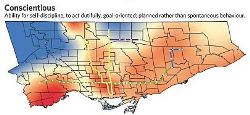
So apparently, if going by where I live is indicative of the type of personality I possess, the good folks at the Martin Prosperity Institute at U. of T.’s Rotman School of Business would conclude that I am a fairly disagreeable introvert who is mildly conscientious but very open to experience with nary a hint of neurosis. Or, I am none of those things but live amidst a high concentration of that type which, at first blush, sounds nothing like my neighbourhood at all. Or maybe the disconnect is due to complexity being shoe-horned into ill-fitting boxes. Like the evil stepsisters trying to cram their big, flat feet into the tiny glass slipper Cinderella left behind.

All of which has to do with an interview I came across recently with Dr. Kevin Stolarick, a Research Director at the MPI. He and his team amassed a database of some 1300 participants from an online personality test in order to discover a link between types of people and where they live. According to Stolarick, personality traits fall into five and only five categories. “No matter what you ask people in behavioral questions,” Stolarick told Meghan Lawson of The Strand magazine last fall, “their answers always fall into the Big Five traits.” The Big Five? Conscientiousness, agreeability, openness to experience, extroversion, and neurosis.

Really? Do our lives break down that cleanly into a mere five categories? Can a 7 million year march through human evolution only have brought us to a point where we can be psychologically fitted into so few, easily defined slots? Sounds more like a marketer’s dream rather than anything even closely resembling reality.

There is also the very real possibility I just don’t have the necessary academic underpinnings to fully comprehend what Stolarick and his colleagues are attempting to do with this study. Into which one of the big 5 personality trait categories is ignorance placed?

It also could be my misgivings about putting much credence into self-reporting tests that serve as the basis for the research of Stolarick et al. As honest as people think they might be, there’s always going to be a hesitancy to ascribe to oneself less than flattering attributes. Do you like to acknowledge the fact that you’re the type that does ‘get nervous easily’ and ‘can be tense’ and ‘who worries a lot’? Wouldn’t you much rather be that person ‘who remains calm in tense situations’ and ‘is a deep, ingenious thinker’? Even just a little? Agree? Strongly disagree?

I gather that there’s a growing science behind putting together a more reliable sort of questionnaire in order to weed out the biggest, fattest liars and that there’s always increased accuracy in larger numbers, still… I find it difficult to fully embrace the veracity of the responses to such intensely personal questions. No, I am not comfortable admitting, even to someone at the end of a fairly anonymous online survey that ‘I see myself as someone with few artistic interests’ and ‘who starts quarrels with others’?

How much information should be deduced from such exercises? Can useful specifics be gathered from such broad strokes? Even Stolarick thinks that “personality is one of those things that doesn’t change very much. These are underlying personality types. Ideally, you should be seeing that these types don’t correlate with anything else.” So, what exactly is he looking for in crunching these types of numbers?

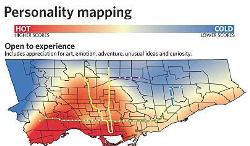
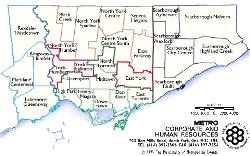
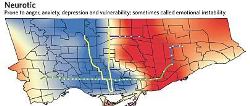
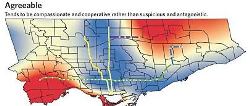
On the plus side, some pretty pictures have emerged from the MPI personality study, using heat diagramming that tells a tale of self-described types and where they reside here in Toronto. It seems that anyone lacking in curiosity lives up in the north end of the city. While all us suspicious and bad-tempered folk inhabit the central region top to bottom (making North Yorkers both close-minded and unfriendly) and stretching out along the lakeshore through the Beaches and into Scarborough. And if you’re neurotic, you better find yourself a place east of Yonge Street unless you want to go around feeling all conspicuous over here on the laid back west side, yo.

It all seems so narrow and confining, if you ask me, especially coming from a think-tank operating under the direction of urban guru Richard Florida. Isn’t he always on about the strength of diversity? Just how diverse are we if we can be so clinically boiled down to 5 kinds of personalities who huddle around other like-minded people? That, to my very open mind with all its introverted disagreeability and ever-so-slight traces of conscientiousness and neurosis, is the exact opposite of diverse; evoking more societal patterns in the Appalachians or medieval Europe. Surely, the complex web of life in a 21st-century, multicultural city like ours goes about its business on a much more complicated level than that.

very unneurotically but quite disagreeably submitted by Urban Sophisticat

Germanically Speaking

Zwischenstadt. One of those malleable German word/phrases that can be both laser-like in its specificity and so hopelessly ambiguous as to be utterly meaningless when translated into English. Like gestalt. Or fahrvergnügen.

Coined by German architect and urban planner Thomas Sieverts, zwischenstadt originally referred to the newer outlying sections of European cities that were built around the old historic centres, largely after the Second World War. The places where urban and rural meet; the ‘sprawl’ on the margins of a city. Adopted and then adapted for a wider non-European meaning, zwischenstadt came to mean the Edge City to Joel Garreau and a Technoburb for Robert Fishman. Ed Soja’s zwischenstadt was Exopolis.

For our purposes here, let us think of zwischenstadt as what is called an ‘in-between city’. These are the largely residential post-war suburbs that sprung up around the inner downtown core of Toronto and once were on the edges where urban met rural but are now sandwiched between the downtown core and the newer, more prosperous suburbs that make up the 905 region. Places like Scarborough and North York that, to borrow a phrase from Julie-Anne Boudreau, Roger Keil and Douglas Young in their book Changing Toronto, operate “in the shadows of Toronto’s glamour zones…”

What’s that? Markham, Pickering and Vaughan? Glamourous?! Yes 416ers, for a good many people, you are not the only game in town as much as that may bruise your collective egos. The in-between city possesses neither the allure of downtown gentrification nor the shiny newness of big houses on big lots in the exurbs.

While both the outer ring and inner core of what is now termed the Greater Toronto Area (GTA) have generally flourished overall during the era of globalization and neoliberal economic policy rule, large sections of the in-between city have fared less well. We now talk of the frayed suburbs and their high priority neighbourhoods that are underprovided with both resources and organization. These are the parts of the city hit hardest when the economy nosedives and the last to reap any benefits that trickle down when times are good. When talk turns to the in-between city, it usually involves crime (Summer of the Gun) or economic insecurity.

A school of urban thought believes that the in-between city suffers from the consequences of our adherence to “… the myth of the ideal compact city…” as Boudreau, Keil and Young refer to it in their book. The suburbs seen as mere satellites of the central core, providing space and more affordable living to those who serviced the needs of downtown. Now with the phenomenal growth of the regions even further on the periphery, the in-between city is neither here nor there. It just is. Its needs and issues, as usual, subservient to those of the core or lost in the tug of war between powerful 416 interests and those in the 905.

Certainly the inner-ring suburbs are receiving little attention so far in the municipal election campaign. The battle lines have been drawn between the wealthier enclaves of midtown Toronto, Etobicoke and North York versus those living between St. Clair and the lake. In the increasingly vigorous move to the right by the leading candidates for mayor and their calls for cuts and freezes at City Hall, the needs of the in-between city like public transit and affordable housing are, in fact, coming under threat.

Mayoral candidate Rocco Rossi has touted his City Builders Fund where he would direct 50% of additional fees that the city receives whenever a development goes beyond existing zoning laws into community projects in high priority neighbourhoods through the Toronto Community Foundation. This is fine as far as it goes but it is simply more of the same approach; public financing dependant on private money and will. It’s highly discretionary and often times a one shot deal that undercuts the notion of an overall plan. There’s no vision.

Without vision, Toronto will continue to stumble along with the increasingly familiar widening gap between the haves and have-nots. There will be those living in the city and those who live in the in-between city. Such an imbalance can only adversely affect our ability to contribute to the region’s growth as a vital economic and social centre. Moreover, by giving into the fiscal pressures of naked self-interest, we are undermining the system as a whole and threaten the very, as I think the Germans might say, gestalt of our city.

Teutonically submitted by Acaphlegmic