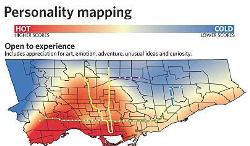
 So apparently, if going by where I live is indicative of the type of personality I possess, the good folks at the Martin Prosperity Institute at U. of T.’s Rotman School of Business would conclude that I am a fairly disagreeable introvert who is mildly conscientious but very open to experience with nary a hint of neurosis. Or, I am none of those things but live amidst a high concentration of that type which, at first blush, sounds nothing like my neighbourhood at all. Or maybe the disconnect is due to complexity being shoe-horned into ill-fitting boxes. Like the evil stepsisters trying to cram their big, flat feet into the tiny glass slipper Cinderella left behind.
All of which has to do with an interview I came across recently with Dr. Kevin Stolarick, a Research Director at the MPI. He and his team amassed a database of some 1300 participants from an online personality test in order to discover a link between types of people and where they live. According to Stolarick, personality traits fall into five and only five categories. “No matter what you ask people in behavioral questions,” Stolarick told Meghan Lawson of The Strand magazine last fall, “their answers always fall into the Big Five traits.” The Big Five? Conscientiousness, agreeability, openness to experience, extroversion, and neurosis.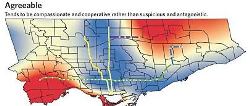
Really? Do our lives break down that cleanly into a mere five categories? Can a 7 million year march through human evolution only have brought us to a point where we can be psychologically fitted into so few, easily defined slots? Sounds more like a marketer’s dream rather than anything even closely resembling reality.
There is also the very real possibility I just don’t have the necessary academic underpinnings to fully comprehend what Stolarick and his colleagues are attempting to do with this study. Into which one of the big 5 personality trait categories is ignorance placed?
It also could be my misgivings about putting much credence into self-reporting tests that serve as the basis for the research of Stolarick et al. As honest as people think they might be, there’s always going to be a hesitancy to ascribe to oneself less than flattering attributes. Do you like to acknowledge the fact that you’re the type that does ‘get nervous easily’ and ‘can be tense’ and ‘who worries a lot’? 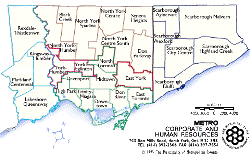 Wouldn’t you much rather be that person ‘who remains calm in tense situations’ and ‘is a deep, ingenious thinker’? Even just a little? Agree? Strongly disagree?
I gather that there’s a growing science behind putting together a more reliable sort of questionnaire in order to weed out the biggest, fattest liars and that there’s always increased accuracy in larger numbers, still… I find it difficult to fully embrace the veracity of the responses to such intensely personal questions. No, I am not comfortable admitting, even to someone at the end of a fairly anonymous online survey that ‘I see myself as someone with few artistic interests’ and ‘who starts quarrels with others’?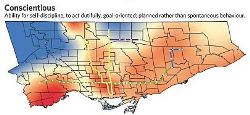
How much information should be deduced from such exercises? Can useful specifics be gathered from such broad strokes? Even Stolarick thinks that “personality is one of those things that doesn’t change very much. These are underlying personality types. Ideally, you should be seeing that these types don’t correlate with anything else.” So, what exactly is he looking for in crunching these types of numbers?
On the plus side, some pretty pictures have emerged from the MPI personality study, using heat diagramming that tells a tale of self-described types and where they reside here in Toronto. It seems that anyone lacking in curiosity lives up in the north end of the city. While all us suspicious and bad-tempered folk inhabit the central region top to bottom (making North Yorkers both close-minded and unfriendly) and stretching out along the lakeshore through the Beaches and into Scarborough. 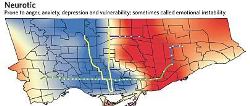 And if you’re neurotic, you better find yourself a place east of Yonge Street unless you want to go around feeling all conspicuous over here on the laid back west side, yo.
It all seems so narrow and confining, if you ask me, especially coming from a think-tank operating under the direction of urban guru Richard Florida. Isn’t he always on about the strength of diversity? Just how diverse are we if we can be so clinically boiled down to 5 kinds of personalities who huddle around other like-minded people? That, to my very open mind with all its introverted disagreeability and ever-so-slight traces of conscientiousness and neurosis, is the exact opposite of diverse; evoking more societal patterns in the Appalachians or medieval Europe. Surely, the complex web of life in a 21st-century, multicultural city like ours goes about its business on a much more complicated level than that.
— very unneurotically but quite disagreeably submitted by Urban Sophisticat