Who’s Got The Wheel?

Yesterday, after the provincial government floated their rather tepid and, perhaps even, cosmetically driven tolls proposal, the following observation was floated on Twitter:

“We have government leaders who have no idea how an urban economy works. And most of this country is part of an urban economy.”

We are now a 21st-century, urban nation with a leadership class still firmly entrenched in the (generously) mid-20th-century. As former NYC Department of Transportation commissioner, Janette Sadik-Khan put it last week, “when you push on the status quo, it pushes back at you.” rolltherock1Or, as our old favourites The Libertines once sang: “…the boy kicked out at the world/the world kicked back alot fuckin’ harder now.”

We have a new federal government that might get it, they might understand the needs of cities, cities making up this urban nation. But, legislatively, Ottawa’s a long way from the ground. Whatever largesse and/or expertise the feds have to offer will inevitably come filtered through provincial and local distortions. So what if we get enhanced federal money for transit infrastructure if it goes to building Mayor Tory’s SmartTrack or the provincially backed and city council approved Scarborough subway? Good money after bad and all that.

Later yesterday, Queen’s Park released a report from the David Crombie led Advisory Panel looking at and making recommendations for the provincial government’s 4 growth plans for the Greater Golden Horseshoe region. The region’s been growing, grown significantly since the end of World War II, and will continue growing significantly over the next 25 years. The population looks to almost double in that time, from 9 million to nearly 13.5 million. Here’s the concern, and some of what the 4 growth plans were brought in to combat:

The extent of settlement has also grown. For example, between 1971 and 2006, the region’s urban footprint more than doubled. Much of the recent urban growth has been in the form of low-density, car-dependent suburbs, providing many residents with affordable, single-detached homes. However, this form of development, often known as urban sprawl, has resulted in loss of farmland, traffic congestion, deteriorating air and water quality, impacts on human health, and the loss of green space, habitats and biodiversity. The changing climate and increasing frequency and severity of extreme weather events create additional pressures on the region’s communities, agricultural production, infrastructure and natural systems.

The Advisory Panel’s recommendations are unsurprising, really. Encouraging intensification through use of “existing urban areas” (while protecting employment lands), greater public transit-based initiatives “to support complete communities” and “greater integration of infrastructure planning with land use planning”, yaddie, yaddie, yaddie. rolltherock3We already know this. None of it is particularly new or noteworthy. I guess it’s worthwhile to repeat and underline these ideas of healthy growth but still…

How many Advisory Panels have we had, telling us the things we have to do to improve this region’s quality of life as it continues to grow? I mean, if Anne Golden had a nickel for every panel she’s chaired to advise government policy, she’d have, what? A dime? Fifteen cents?

Remember her last outing, as chair of the provincially appointed Transit Investment Strategy Advisory Panel? Yeah, it took 3 months to make 20 recommendations for raising revenue to fund the Big Move, leaning heavily on increased gas taxes while rejecting tolls in the short term as “too difficult to implement”. That was 2 years ago. The provincial government’s response to date? Its weak sauce toll announcement yesterday.

The fundamental problem with all these panels is that they tend to come back after studying a policy issue with recommendations that challenge the status quo. Complete communities? What’ll happen to my backyard? Pay for using the roads?! I already pay more than my fair share! I deserve a subway! Subways, subways, subways!!

Pushback from the status quo. Leaders with their ears to the ground can only hear the stamping of feet. Politicians love the word ‘change’ on their campaign signs but blanch in the face of bringing it about, all those red, outraged faces to contend with? rolltherock6Where angels fear to tread, amirite?

Sure, things are bad now but what if these changes you’re talking about makes things worse? Nothing’s 100% guaranteed. Despite all data, information and examples to the contrary, from where I’m standing, the grass over there doesn’t look all that much greener.

Our propensity to fearfully embrace what-we-know so tightly makes for an uphill battle to enact the changes we need. The grade’s made steeper still when our elected officials not only fail to directly address this tentativeness but, in fact, give in to it for even just the slightest step forward. That’s why for every bid our government’s pitch for increased public transit funding and investment, we see assurances of road and highway expansion. Despite working at cross purposes, to attempt to even slightly modify the status quo, we must show that the status quo won’t change that much.

Speaking at Simon Fraser University just a month or so after submitting the report and recommendations of the Transit Investment Strategy Advisory Panel, Anne Golden talked about a government’s need for trust from the public in order to pursue new measures like revenue generation for transit building. rolltherock‘Tax grab’ is an almost immediate reaction from a skeptical public, digging in their heels further against any sort of change. There has to be buy in based on a belief that it’s not only going to be money well spent but be beneficial to everyone. What’s in it for me?

When you have a reputation of not spending money wisely which the Liberal government at Queen’s Park has certainly earned, or when your transit plans appear to be politically motivated and easily subject to the whims of parochialism – Hello, Scarborough subway! – public trust is in even shorter supply. Resistance to change grows stronger.

You can point all you want to places that have turned the corner, embraced changed and a new approach to mobility and city building. Look! New York’s doing it! Don’t you want to be like New York? You always want to be like New York! But we look around closer to home and see what all needs to be done, what we’ve done so far and conclude such change is beyond our reach. The Sheppard subway remains a glaring white elephant with the Union-Pearson Express set to join it. We can’t even muster the will to clear road space for our busiest transit routes like the Finch bus or King streetcar. rolltherock4How on earth can we expect to meet the challenges of the 21st-century?

I’m sure plenty of our government leaders are well aware of how a modern urban economy works. What they don’t know is how to convince enough of us that we need to move in that direction. Too many flinch at the slightest sign of resistance, retreat in the face of loud, blustery noises.

It’d be great to leave off on that note. Place the blame elsewhere and carry on, absolved. But, you know, that old saw nags, a variation on getting the leadership we deserve. Not enough of us have been pushed from our comfort zone. Things are bad but they’re not that bad. They could always be worse.

Until such time, when enough of us conclude that, in fact, it is that bad (never an easily determined point on the scale), we’ll hum and haw, rail at the ineffectualness of our elected officials and uncaring bureaucracy, wonder about why we’re not those other places, doing exceptional, exciting things and hope that it won’t be too late to make those changes we were urged to make years, decades earlier.

rolltherock5

rocknrollingly submitted by Cityslikr

Wheeling And New Dealing

Let me run a hypothetical by you here.whatif

A pedestrian illegally crosses a street, grievously misjudging how fast an oncoming car is moving, say, 20 kilometres over the legal speed limit. Pedestrian is struck. It’s called an “accident”.

Who’s at fault in this case?

Pedestrian shouldn’t have been crossing the street at that spot. The driver has the right of way. But what rights does a driver forfeit by not adhering to posted speed limits?

I pose this, having made my way around my area of town over the weekend, exclusively on foot, taking advantage of the pleasant late fall weather, observing and participating in – excuse me while I butcher Jane Jacobs — our mobility ballet.

And I can only arrive at one simple conclusion: cars remain the prima ballerina assoluta of the dance. Even in the heart of the downtown core, in spots of the city never designed or unnaturally rejigged for car use, private vehicles rule the roost. roadrage1They dictate the speed and tone of place. In spots, their dominance has been challenged but not seriously so.

Cars speed. Cars park and stop illegally. Cars block bike lanes and transit stops. Cars blow past open streetcar doors. Cars are regularly driven by people using their cell phones. Cars browbeat other road users through intimidation (some intentional, some not) and the always present threat of injury and death.

Yes, cyclists break the law too. Pedestrians disobey traffic lights. But their disregard rarely alters the flow and feel of the streetscape or impinges on others.

As I responded to a reader of this site who had commented to a post last week about the need for non-drivers to accept responsibility for their actions on the roads and sidewalks, Pedestrian makes a mistake, is struck by a car, pedestrian dies. Driver makes a mistake, strikes pedestrian with their car, pedestrian dies. The dynamic is unequal. The burden of responsibility should always be placed on those capable of inflicting the most damage. Drivers should always drive like a 4 year-old could suddenly pop out of nowhere right in front of them. chalkoutlineDrivers should always drive like that elderly gentleman ahead of them won’t make it across the street as quickly as you might think.
I was making my way up an alley early Friday evening, in the dark, as it tends to be in these parts this time of year, when a big fucking pick-up truck came barreling toward me. I don’t know what the speed limit is in our alleyways but this driver was going faster than the limit would be on the road just parallel west of us. Unsurprisingly, I tucked in out of the path of the truck. If I didn’t, I’d be dead. That’s how fast this vehicle was moving. I knew it. The driver knew it. It was my job to get out of his way.

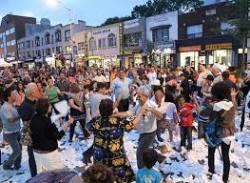
On two separate runs over the weekend, making my way along the sidewalk, cars pulled out of blind alleys, blowing right through the sidewalk and stopping at the road just beyond that. There had been no one that the drivers could see walking in front of them, so they just continued forward, operating under the assumption that any pedestrians coming that way would stop for the car. streetfestWhy? Because they’d have to, for their own personal safety.

Why is it that pedestrians and cyclists are forced to go about their business always on the lookout for some inattentive driver just lurking around every corner or alley, not paying them equal attention? The answer’s simple. Because our lives depend on it.

In order to change how we get around this city, we have to transfer the risk of “accidents” and altercations to where the possibility of inflicting damage is most. Car drivers. There has to be serious consequences for drivers who fail to adapt their driving to the circumstances they’re driving in. That means slowing down, always yielding to more vulnerable road users, shouldering the responsibility to ensure no loss of life or injury.

Drivers should be as fearful of driving in the presence of pedestrian and cycling traffic as pedestrians and cyclists are afraid of travelling in the presence of cars.

In case you think I’m just talking some radical, utopian, Eurotrash talk, read the Globe and Mail’s Oliver Moore on the former New York City Department of Transportation Commissioner, Janette Sadik-Khan’s talk last week. deathrace2000In short, that city’s gone hard and quickly in reordering its road and street hierarchy, placing private vehicle use right down at the bottom of the list. “Moving at the speed of life,” I believe she called it. As a matter of fact, drivers, you don’t own the road.

In some places, at least. Not any longer. While we here in Toronto are still moving about in the dark ages.

repeatedly submitted by Cityslikr

This Is Not A New Message

Just in case you were wondering, I am indeed acutely aware of my increasingly out there position on the Mayor Tory crank scale. Where others detect glimpses of positive in his governance approach, I see lapses of courage and conviction. Well, at least it’s something leadership now passes for a welcome breath of fresh air. It Could Be Worse, Our Strength.

But honestly, I look at this…

johntoryvision

… and think, Are you fucking kidding me?

That picture and headline (taken from a news article) strikes me as more depressing and discouraging than anything I saw during the Ford administration. Yeah, seriously. You could take comfort, albeit a cold kind, during the Ford years, warmed by the knowledge that the darks days couldn’t last. Wobbly almost from the outset through the weight of sheer incompetence and personal demons, it had to eventually, and fairly quickly as it turned out, come crashing down. Shocking for sure but kind of like an unsuccessful siege. Damage inflicted but the fundamentals left intact, relatively sound.bloodied

Perhaps the worst outcome of the Ford mayoralty is that now, a full year out from its official end, we as a city reward any politics that aren’t crack and booze fueled. We grant anything as ‘vision’ that isn’t… a-hem, a-hem… blurred. Doing the right thing means not doing the wrong thing.

Mayor Tory’s proposed .5% Capital Building Fund levy is the wrong thing going generally in the right direction. But times being what they are here in Toronto, the Ford spectre still looming large, we call such an announcement visionary. ‘Modest’. ‘Sensible’. ‘Workable’. ‘Unsexy’. Even, incredibly, ‘a new vision’.

After writing about this yesterday, I sat down and re-watched City Manager Peter Wallace’s budget pre-presentation, let’s call it, to Executive Committee this week. I urge everyone to take 30 minutes or so and give it a look. It’s clear, easy to follow and very direct about what we have to do (and what won’t really work) in order to develop a sustainable fiscal plan (especially on the capital side of the ledger) going forward.

I want to focus on this one slide. (Lifted right from Steve Munro as I’m too much of a technical knucklehead to figure out how to convert a PDF to JPEG. Thanks, Steve!)

stateofcityfinanceschart

While it is true that, since 2000, Toronto’s property tax rate increases have been kept to below the rate of inflation, all property taxes have not been treated equally. In order to bring certain business and ‘non-residential’ property taxes (including some very residential apartment buildings) more in line with other GTA municipalities, in the spirit of competitiveness, the Miller administration set in motion a re-jigging of the ratio between residential and non-residential rates. wonkyIt’s a process that’s still going on but, in effect, it’s meant that any property tax increase over the last decade or so has been felt more heavily on the residential side.

Now, while I still believe that for the services we receive and demand from the city, Toronto homeowners are getting a pretty sweet deal on their property taxes, the dynamic as shown in the above slide from the city manager provides a picture of why they may be feeling a little squeezed. Since about 2005, residential property tax rate have gone up above the rate of inflation. In a surprising bit of information, and running contrary to the Ford narrative of respecting the taxpayers, the city manager pointed out that over the past 4 years, residential property tax hikes have gone up at an increasing rate!

So, homeowners, those vaunted hardworking tax payers, have not been wrong in feeling that they’ve been squeezed, certainly in terms of their property taxes.

Listening to this, reading through the prepared documents, what is Mayor Tory’s response? To increase property tax rates by an additional .5% above whatever annual bump will happen. fingerscrossedbehindbackHe and his supporters can call it a levy. They can try to pretend it’s something it isn’t. But it’s a property tax increase.

I don’t think it’s accidental that throughout the Executive Committee presentation, the city manager continued to point in the direction of the Land Transfer Tax. He called it a lifesaver, and that without it, the city would’ve been forced to face the financial wringer sooner. Lookit it, people. Lookit this source of revenue. Controversial? For some. Sustainable? Probably not, and certainly not at the level it’s been at during our housing market boom. But lookit it. You see what the city manager sees? It’s not the property tax.

This is why Mayor Tory should not be applauded for his announcement. An additional property tax isn’t in any way, shape or form ‘a new vision’. In fact, it’s just the opposite. Even Rob Ford was in favour of increasing the property tax to help fund his Scarborough subway vision.

Mayor Tory was presented with an opportunity for a wider conversation about revenue tools and he chose to ignore it. charliebrownInstead, he simply continued to pile on the property tax base, and at a rate that, in the end, won’t even make much of a dent in the capital state of good repair backlog let alone build anything much new. And if one nickel comes out of this fund for SmartTrack… ?

When we come up short again — and the proposed implementation date of this Tory tax in 2017 means we’re already short in 2016 – and another round of discussions about revenue tools raises its head, people will be indignant. We are being nickel and dimed to death! What about that .5% levy, they’ll ask. Where did all that money go?

At best, this should be seen as a sideways move, a side-step, another dodge by a politician unwilling to face up to reality. Yet, for Mayor Tory, it’s like he’s invented the wheel. It’s not much (modest) but it’s better than nothing (workable). This is exactly what exceeding exceedingly low expectations looks like.

crankily submitted by Cityslikr