Mr. Fantino Goes To Ottawa

On the plus side, Toronto, at least we won’t have to worry about incoming mayor Rob Ford bringing back Julian Fantino as police chief.

Besides, by-elections are meaningless, right? We shouldn’t use them to take an accurate political pulse of the nation especially with less than 1 in 3 eligible voters bothering to cast a ballot. Let’s just view this as an entertaining, engaging and diversionary blip on the radar until the real deal comes around.

Otherwise, Julian Fantino’s election victory as Conservative M.P. for the federal riding of Vaughan is grim, grim electoral news. Like we need anymore of that in these parts right now.

Because if we were to read too much into it, it would suggest that the scaly, life-draining tentacles of the Stephen Harper led Conservative government are slowly gaining traction in areas of this country that’ve been, up to now, unyielding to their oily clutches. By running a successful peek-a-boo campaign that has largely kept their candidate from a wider public view shielding both him and the party itself from any significant scrutiny, they’ve set the stage for a policy-free, personality first general election. Issues? What issues? “Give me an issue, I’ll give you a tissue, you can wipe my ass with it.”  (h/t Lou Reed, Take No Prisoners.)

How could the voters of Vaughan, or at least the 16% or so of them that voted for Julian Fantino… and boy, if that number doesn’t send shivers down your spine, 16% of voters sending an M.P. to Ottawa, even in a by-election, then the notion of democracy is truly dead to you… not have been offended by the treatment they received during in this campaign? Fantino sat out almost every candidates’ debate. His campaign videos were shockingly hackneyed, devoid of substance and lifelessly delivered as if the man had never been in front of a camera before. He was a “star” candidate who seemed almost put out that he actually had to publicly campaign for the position. Shouldn’t I just be appointed? That’s how things are usually done in the circles I run.

The fact that someone like Julian Fantino could actually be considered a “star” candidate is the other bitter morning after pill to swallow. Being a “star” should involve something other than name recognition. Possessing political views and opinions that rise above bumper sticker sloganeering is too much to ask? ‘Law And Order’ and ‘Tough On Crime’ make great TV series titles but spouted mindlessly by a “star” candidate suggests a thin veneer painted over a warm body that masks a total lack of understanding about what’s going on out there in the wider world. But, I guess, in this day and reality age that may be expecting a bit much from our politicians and says more about my complete and utter incomprehension of how the world actually works.

A quick look at Fantino’s resumé shows a man who has gracelessly bulldozed his way up the food chain and into being a “star” political candidate. For almost 20 years now, the man has been dogged by controversy as he trampled over civil rights and fuzzy lines of legality at almost every post he served throughout his career. There was the illegal wiretapping of Susan Eng, then chair of the TPSB in 1991. As police chief in London in the mid-90s, he arrested and charged a couple dozen gay men as part of a child pornography ring that turned out to be non-existent. His tenure as Toronto’s chief of police was pockmarked by more ill-advised confrontations with the gay community and corruption scandals within the force itself that Fantino was accused of not rooting out vigorously enough. Then, as OPP commissioner there came further accusations of unauthorized wiretapping, more dubious child pornography rings busted, along with a charge of ‘attempting to influence an elected official’ thrown in that was subsequently dismissed by the Crown due to the always reassuring ‘no reasonable prospect of conviction’ grounds. His involvement in this past summer’s G20 fiasco, both on the ground and the money spent has yet to be fully disclosed but early signs suggest another less than stellar performance review.

All it takes, it seems, to be a “star” candidate is a high profile regardless of how that came to be. “There’s no such thing as bad publicity,” Brendan Behan said, “except your own obituary.”

Essentially Julian Fantino is an admirable, “star” candidate only to those who pine for the days of hard-nosed cops in B-movies (take a bow, Don Cherry), many of whom apparently occupy senior positions in our political establishment. Rumour has it, Fantino was hotly pursued by both federal and provincial Liberals before he anointed the Conservatives in Ottawa as his party of choice, revealing the paucity of ideas and absence of democratic ideals in our two leading parties. What was promised him in exchange for his fidelity – Fantino does know that’s there’s no King position in a parliamentary system, I hope — time will tell but in the cold, dark morning reality, just a few hours after his win, I do feel a certain bit of relief mixed in with the disbelief, bewilderment and dollop of despair. At least, off in Ottawa and as an M.P. in the 905 region, he will be that much more removed from us here, ever so slightly out of our hair, buried deep in the smothering anonymity of the Conservative caucus, never to be heard from again. (Fingers crossed!) I mean, the man couldn’t possibly bluster and blunder his way into any further, more influential positions of power, could he?

curiously submitted by Cityslikr

When Governments Shrug

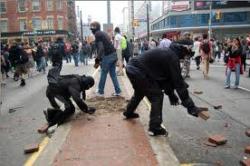
Last week’s Canadian Civil Liberties Association/National Union of Public and General Employees hearings into security force conduct at June’s G20 Summit in Toronto revealed few surprises except, perhaps, the degree to which lawlessness prevailed. We all know about the Black Block and the burning of a police car during the brief but damage filled riot that broke out on the Saturday of that weekend. How could we not? It was international news.

But equally, and far more sinister, was the conduct of the police force and the shocking assault not just upon peaceful protesters but the very foundation of our democracy before, during and after the summit. Peace, Order and Good Government? All tucked away nice and neatly. Noble sentiments in theory but, come on. This is the post-9/11 real world we’re talking about here, where the idea of “security” trumps all.

Even if the smallest fraction of what was said during the 2 days of hearings last week were true (and there’s absolutely no reason so far offered why I would assume there wasn’t far larger degree of truth being told), we should already be knee deep in some sort of public inquiry. Pre-summit arrests of various social activists. Police going badgeless (therefore nameless) while conducting highly questionable tactics with dubious claims of legality. Onerous bail conditions set on some detainees afterwards that suggest we’re dealing with the most nefarious of Al-Qaida suspects. Even in the pages of one of our more hawkish right wing dailies, there was a tentative call for a public inquiry.

And yet, to date all 3 levels of government have merely shrugged their shoulders. Whaddayagonnado? A few bad apples. Dock a day’s pay. Let’s move on. Nothing to see here.

In other words, people, go fuck yourself.

It’s almost as if we’re asking for a favour. A special dispensation handed down from on high. An indulgence granted by parliamentary privilege. Like we have no say whatsoever in how our governments and, by extension, those they oversee like police forces operate.

In his National Post piece above, writer Chris Selley asserts “Most people trust the police, and in general they should.” It’s his statement’s ‘in general’ qualifier that stands out. Shouldn’t we trust the police implicitly? Given the powers vested in them to, when deemed necessary, intrude into our private lives and personal freedoms, shouldn’t we demand full and open accountability at all times? Democracy and freedom are easy when neither’s being tested. The real measure happens when they come under duress. That’s exactly what happened at the G20 summit and by all accounts we failed them both miserably. It might be beneficial to try and figure out why.

Unless of course we don’t ultimately care. I mean, how often do we host G20 summits anyway? Police crackdowns are hardly ever necessary in the grand scheme of things.  It’s not like the security cameras remain up or lists are kept to monitor future activities. Right?

Yet for some reason, the ultimate villain in Mr. Selley’s article is Naomi Klein. Naomi Klein? Wait, how did she become—Oh right. Whenever criticizing the police, however mildly, don’t forget to raise the specter of a “radical” bogeyman, just so readers will remember what or whom the police are up against. In this case, outspoken lefty Naomi Klein who had the gall to praise student rioters in the UK for smashing up the 1st floor of Conservative Party headquarters to protest yet another hike in university tuition fees breaking a promise made when the coalition government was formed.

Naomi Klein is pro-riot. Naomi Klein is pro-G20 summit public inquiry. Therefore, G20 summit public inquiry = riot. Anarchy ensues if police aren’t allowed to trample our civil rights. Read between the lines, people.

Why are we more tentative in our criticisms of some displays of lawlessness than we are of others? In fact, shouldn’t we be much more vigilant in guarding against allegations of illegality conducted under the auspices of those entrusted to uphold the law? Doesn’t that present a much bigger threat to our civil society than the violent outbursts of citizens driven to such desperate acts because of oppression, neglect or ongoing and systemic disregard by those we elect to serve our interests?

No matter how sympathetic I may be to a cause that results in violent protest – and I think a democracy takes Tearing Up Some Shit off the table at its peril – I fully expect those who participate in such actions to be ultimately held responsible for their actions. Arrest and prosecution, all in proper legal fashion. Why is it so difficult to expect the exact same process for our police, its leadership and our own? It’s a dangerous double-standard and one we imperil our way of life with if we continue to hold it.

judiciously submitted by Cityslikr

Chris Hedges’ Bleak House

A commenter to a post from last week accused me of being “optimistic”. Downright Pollyannish compared to the likes of one Chris Hedges. Well, I never. Of all the nerve. I dwell in the darkness. No glass is full enough that I can’t see as half empty. Optimistic? How dare you, madam commenter!

Now, I am secure enough in my ignorance to admit that I wasn’t sure who this Chris Hedges was or anything about the book Death of the Liberal Class. A Google search followed and, well oh well, I have to admit that the commenter was absolutely correct in her assessment. I am a veritable Santa Claus, bringing joy and happiness to the wider world when put up against Chris Hedges. Where he’s seen fire and rain, I’ve seen sunny days that I thought would never end.

In my defense, I have not spent any time whatsoever in the world’s war torn hotspots like El Salvador back in the day, the former Yugoslavia back in the day, northern Iraq during Saddam Hussein’s violent suppression of Shia and Kurdish rebels in 1991. I did not leave a high profile post at the New York Times after receiving a formal reprimand from the paper for my denunciation of the Bush administration for its invasion of Iraq. So the opportunity to truly blacken my soul and shrivel my heart has not been offered up to me as it has Mr. Hedges. To such a consummate professional as he, years and 1st person experience combine to provide a dark view. Me? A mere dilettante, an armchair cynic.

So I bought me a copy of Mr. Hedges Death of the Liberal Class from a locally owned, independent bookstore and set down to reading it. Since I’m only a couple chapters in, this isn’t any sort of review but the premise of the book goes something like this: the liberal class, consisting of the media, academia, labour movement and moderate religious institutions, historically acted as the “safety valve” that fought for, at least, “incremental reform” in the face of the vested interests of the “power elite”. But with the rise of the “corporate state”, Mr. Hedges claims that “the liberal class has distorted its basic belief systems to support unfettered capitalism, the national security state, globalization, and staggering income inequalities.” In so doing, it has “relinquished its moral authority” and ceased speaking for the working and middles classes, helping feed the anger that’s given rise to such movements as the Tea Party (and, dare I say it? Rob Ford here in Toronto.)

A dust jacket synopsis to be sure and I bring it up because, despite Chris Hedges’ pedigree including a Pulitzer prize, such a position as he takes in this book will surely relegate him to the fringe bin. That place we put people who spout uncomfortable ideas and question the conventional wisdoms we as a society operate under. It already occurred when Hedges appeared on The Agenda a couple weeks back. During the debate segment of the show, fellow media liberal class member Tony (“The World’s Not Perfect But…”) Keller politely dismissed Hedges’ book treatise as too conspiratorial. Implicit in that argument is the sentiment, and where’s your tinfoil hat, Chrissie?

Why I find all this interesting enough to write about is that at the same time I was discovering Chris Hedges, in an unrelated matter I coincidentally encountered what is now referred to as the Powell Memo. Written in 1971 by Lewis Powell just a couple months before he was appointed to the U.S. Supreme Court by Richard Nixon, it was sent to Eugene Sydnor, a Chamber of Commerce mucky-muck, and outlined a battle plan for beating back the opponents of America and its free enterprise system. “No thoughtful person can question that the American economic system is under broad attack. This varies in scope, intensity, in the techniques employed, and in the level of visibility. There always have been some who opposed the American system, and preferred socialism or some form of statism (communism or fascism). Also, there always have been critics of the system, whose criticism has been wholesome and constructive so long as the objective was to improve rather than to subvert or destroy. But what now concerns us is quite new in the history of America. We are not dealing with sporadic or isolated attacks from a relatively few extremists or even from the minority socialist cadre. Rather, the assault on the enterprise system is broadly based and consistently pursued. It is gaining momentum and converts.

The irony of this memo is rich and the disengenuousness of it deep. Before assuming his position on the bench, Lewis Powell was a corporate lawyer whose firm represented various tobacco companies. Powell himself sat on the board of Phillip Morris. So yeah, the 60s were a bad time for businesses like tobacco (Damn you, 1963 Surgeon General’s Report!), as government slowly interceded in tying their hands in peddling their poisonous products and marketing them as ‘healthy alternatives’. Powell expresses special disdain for the likes of consumer advocate Ralph Nader and thought it high time for right thinking American business leaders to stand tall against the creeping insidiousness of anti-consumerism and environmentalism.

More interesting about the Powell memo (or at least, more relevant to this discussion) are the pages and pages written, targeting the culprits (**cough** Communists! **cough**) of said attack on the American way of life and the remedies to combat it. Campus, media and the pulpit. That there would be a huge overlap with Chris Hedges’ pillars of the liberal class. Academia, media and moderate religious institutions. So three decades ago influential business leaders targeted what they saw as opponents of free enterprise (“The threat to the enterprise system is not merely a matter of economics. It also is a threat to individual freedom”) and set out to reverse their influence.

Whether or not they succeeded in doing so is not the point of this post. Clearly writers like Chris Hedges think they did. But to dismiss his arguments purely on the grounds of being ‘conspiratorial’ as Tony Keller did is lazy and suspect. Mr. Hedges has earned his dim world view by engaging it on the ground. Those disagreeing with him based solely on the notion of his ideas being too fantastical really only serve to prove the point of his book. We purporting to be of the liberal class are our own worst enemies.

liberally submitted by Cityslikr