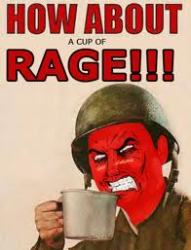
Admittedly, I did not spend much time in Mayor Rob Ford’s head. The discomfort was too bearable. It was all blindingly red, the colour of rage and perpetual indignation.  At times so intense as to render me unconscious, only to be revived by the sweet smell of chicken wings.
So, I was never able to figure out just what is going on in the mayor’s mind that keeps him so mum about the ongoing federal election campaign. Here he has this bully pulpit which he’s not been shy to use to come down on his particular pet peeves like councillor spending, social housing, public transit and yet on pushing forth a municipal agenda, Mayor Ford’s been L’il Miss Demure. ‘Respect for Taxpayers’ has been as much as he’s managed to type out, allowing a grand opportunity to pass him, and us – and by ‘us’ I don’t mean just us in Toronto but the overwhelming majority of us who live in metropolitan areas throughout the country — by.
 The need for such proactive measures has not been greater. Municipalities in Canada are facing increasingly dire circumstances, symbolized by a four year-old estimate of an accumulated $123 billion infrastructure deficit. This cannot be handled individually by nibbling around at discretionary spending corners and stopping the gravy train. As we heard at yesterday’s Who Cares About 15 Million Voters? (h/t @_john_henry @MartinProsperiT), Canada’s 19th-century governance structure does not enable cities to deal with the problems they face on their own. The numbers simply don’t add up.
And the timing could not be more propitious for our mayor to step up to the plate. His political stripe is no secret. The federal finance minister is a family friend. If polls and opinions are to be believed, there are actually some seats in Ford Nation that are in play for Conservatives. (NOW has 5 possibly up for grabs that could turn blue from red.) These could be the difference between a win and a loss, majority versus minority for Stephen Harper. So why isn’t the mayor leveraging this opportunity to highlight urban issues? More specifically, imagine the oomph behind his ask for help in building the Sheppard subway from the feds if he helped secure the Conservatives even 1 or 2 416 ridings for them.  It would go a long way to re-election in 2014.
Could it be his silence is, in fact, very tactical? By pushing an urban agenda is there some concern about alienating the even more important 905 region? That urban-suburban divide that politicians in Ottawa (and Queen’s Park) so love to exploit to their advantage might flare up against them if they’re seen to be catering to the bigger cities. Perhaps the Conservatives have asked the mayor to remain on the sidelines and let them have it in the greater GTA. If things fall their way, then maybe there’ll be a little something in it for him afterwards.
Of course, it may be worth considering that the vaunted Ford Nation that the mayor threatened to unleash on Premier McGuinty earlier this year – and it will be interesting to see if Mayor Ford maintains his disengagement during the provincial election in the fall – may not be as vaunted as he hopes.  What would happen if the mayor got all involved in the campaign and had little to no to negative impact on the outcome? It wouldn’t diminish his abilities to run the city certainly but it might poke a hole in the invincibility suit he’s been wearing since his election. And if the Conservative horse he backed didn’t win? His ability to bargain at the federal level might be lessened down the road.
Setting partisan campaigning aside, and wondering why Mayor Ford has refused to pick up the urban banner during this election, it may just be more ideologically based than anything else. To step up and demand federal government action in helping cities meet the burdens put upon them would repudiate everything that brought the mayor to power. Echoing the sentiments made by Calgary’s Mayor Nenshi admits to what the mayor refused to admit to his entire political career. Cities do have a revenue problem. If Mayor Ford gives voice to that idea, then everything he ran on, all the damage he’s inflicted on the city right now under the rubric of fiscal responsibility could be seen as unnecessary, mean-spirited and nothing more than pure politics. If that’s the case, if that’s reason for the mayor’s continued absence from the federal election scene, well, it’s as damaging as anything he could by being more involved. It suggests he’s looking out for his own best interests rather than those of the city. Respect for the taxpayers indeed.
— questioningly submitted by Cityslikr
 While the situation in DC is much more extreme, having neither full voting representation at the federal level (except for 3 votes in the electoral college) or a state mechanism to stand up for it on a national stage, it reflects a city’s lowly place in the political hierarchy. “Creatures of the province” we are in Toronto and elsewhere in Ontario, Washington is a Constitutional article, proclaimed into existence from the perceived necessity to provide a secure site for all three branches of the federal government. A compromised location where it is not because that’s where the people were but because it’s where north met south.
 To secure a deal, the President allegedly gave over certain aspects of the city’s social policy like access to abortion and needle-exchange to the Republicans in order to secure wider funding for Planned Parenthood.This led to Tuesday’s