At least today, we do.
Over at the Torontoist.
Click here to see how we act when we’re not slumming in niche sights like this one. We’ll be back, however. We always come back.
That’s a promise. And a threat.
— haughtily submitted by Cityslikr

At least today, we do.
Over at the Torontoist.
Click here to see how we act when we’re not slumming in niche sights like this one.We’ll be back, however. We always come back.
That’s a promise. And a threat.
— haughtily submitted by Cityslikr
 I like my magazines like I like my condiments. Just slightly out of date and not bland.
Reading through them a few months, half a year behind, it offers up immediate hindsight. An automatic retrospective that allows for quick judgment as to how well a writer grasped the subject at hand. Instant historical perspective.
So it was as I made my through the Spacing magazine’s Fall 2010 issue. One article in particular caught my attention, Deck the Allen by Jake Schabas. It offered an overview of the Allen Expressway and the various attempts that have been made since the early-70s to integrate what is, essentially, just a false start more fully and functionally into the neighbourhoods it so hideously slices through and divides.
A name jumped out at me as I read the article. Esther Shiner. First elected as North York alderman in 1972, and then the city’s Board of Control in 1976 which earned her a spot on Metro Council where she served until her death in 1987. During the 1980s she also served as Mel Lastman’s Deputy Mayor in North York. An early proponent of amalgamation way back in the 70s, her enduring claim to fame, however, appears to be her ardent support of the Spadina Expressway. So much so, she earned the nickname, ‘Spadiner Shiner’. When the project got bogged down after it made its initial way from the 401 to Lawrence Avenue, she fought successfully to push it further down to Eglinton where it remains today, known as the Allen Expressway. ‘Spadiner Shiner’ continued to press on with the project even after successive provincial governments and city councils had bowed to citizen pressure to halt it. According to Mr. Schabas, Shiner was also very instrumental in the ultimate auto-centric nature of the Expressway, helping to beat back plans (including one proposed by Buckminster Fuller. Buckminister Fuller, people!) that arose to make the Lawrence-Eglinton section part of a broader development that included parkland, public transit hub and residential and retail space.
Esther Shiner can also be credited with being the mother of current councillor, David. A former budget chief of Mel Lastman, Councillor Shiner was recently in the news for his spiking of the proposed Fort York Pedestrian and Cycling Bridge in late April as a member of the Public Works and Infrastructure Committee. ‘Too fancy’, he thought it, and his motion to deny the city giving final approval on the already approved project sent it back to the drawing board for a proper scaling down. The times have changed, it seems, but the results are about the same, laced though they may be with a lethal dose of irony. Esther Shiner was all in favour of plowing money into bulldozing and disfiguring downtown neighbourhoods to make way for a highway. Her son, David, withholds a miniscule amount of money to halt the building of a bridge that would’ve brought together neighbourhoods now divided by a highway.
Two generations of public service to Toronto, dedicated to draining life from the city one bad choice at a time.
— belatedly submitted by Urban Sophisticat
or
People Got To Move
When I think about those nights in Montreal…
… I get the sweetest thoughts of me and Bixi.
 If there is a better way to see a city, to visit the nooks and crannies, get to neighbourhoods one might normally overlook while visiting another city, it hasn’t been invented yet.
Bixi, baby. Bixi.
2 years older than the Bixi Toronto with roughly 10 times the bikes and stations, Montreal offers up a vision of just how well a bike sharing program can serve a city. Yeah, yeah. I know it’s in the hole right now. Great ideas don’t always immediately take. And judging from the expressways and multi-lane roads running throughout the downtown core, Montreal is no less a car-oriented place than we are here. So it’s going to take time. But to abandon it at this early stage would be an admission that cycling really isn’t a vital component of your transit plan.
Travelling around a wide swath of Montreal on the Bixi network is pretty well effortless (if you don’t include trying to scale that one big mountain in the middle of the place.) The rhythm goes something like this: bike, walk, bike, walk, walk, bike, patio, bike, walk, patio, bike, walk, walk, patio, walk, patio, walk, bike, patio, patio, patio… You could replace some of those patio stops with a gallery or two. Shopping if you really must although, why would you when it takes time away from riding? And patio visiting.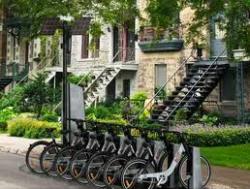 Of course, a bike sharing program alone cannot bring cycling to a wider number of users. People must be comfortable taking to the roads and that can only happen when they feel welcome onto a city’s streets, big and small. That means more accommodation to cyclists and an acknowledgement that the roads belong to them too. Without that, the Bixi idea will be little more than the cute novelty the name suggests.
— besottedly submitted by Cityslikr