Mayor Tory Went To Asia And All We Got Was This Terrible Transit Idea

Can we agree on a format going forward?

If I accept the inevitability of the introduction of the private sector involvement in the providing of public transit line of reasoning into the debate, quidproquocan we move beyond the blanket statements and off the top of my head ideas about how it’ll work?

As you probably know by now, Mayor John Tory went on a trip to Asia and came away wowed by the state of public transit in the region. How couldn’t he be? Hong Kong. Shanghai. Beijing. A Toronto transit user can only look on at those systems and weep.

And what was the mayor’s transit takeaway from the trip?

We probably can no longer, and should not, close our minds to the possibility that either alongside the public sector, or in some cases instead of the public sector, that you would look at having somebody else run some of these things.

That ‘somebody else’? The private sector, of course.spitballing

This shouldn’t be surprising. We elected a mayor who sees the world through the lens of Bay Street-tinted, pro-business, free market glasses. If there’s a problem that needs fixing, the private sector can do it. That’s his thing. Fine.

But he, and all those advocating for more private sector involvement in delivering up more public transit, really need to start putting some meat on those bones. “Private-sector involvement in transit operations is not, in itself, unusual,” writes Oliver Moore in the Globe and Mail. “London’s fleet of iconic red buses is actually run by a variety of private firms. Hong Kong’s MTR is listed on the stock exchange, with the government as majority shareholder.”

Alright then. How are these examples applicable to Toronto? Do we need Hong Kong like density to attract private sector involvement? jitneybusShould we put a second deck on our buses? Provide some details, please.

It’s not enough to say ‘the private sector’ like it’s some magic charm that will summon new subway lines from a puff of smoke. We’ve been down that road before, just recently in fact. Ahhh, memories.

So far, this mayor’s thoughts are no less vague. ‘Air rights’ to develop over rapid transit stops that the private sector builds. “…expanding transit-building contracts to include long-term operational responsibility,” is another idea cited in the Globe article. “He [Mayor Tory] mused also about private firms providing small-bus service, perhaps in suburban areas,” Moore writes.

Jitneys! Why doesn’t Toronto have more jitney service like they do in developing countries like… the Hamptons? Unleash the wonders of free enterprise, with small-bus operators competing for precious suburban commuter dollars, keeping fares low and service levels high in the process.

Look, my views on this are pretty firm. I regard public transit as a public asset not a commodity. showmethemoneyIt should not be reliant on the profit-motive to justify its existence. In fact, I truly believe those two things are in direct conflict with each other.

But hey, that’s me. My thinking on this could be too rigid. I will admit to that. I am willing to open my ears and my heart and my head to opposing views.

Tell me exactly how it would work. Give me concrete proposals. Show me how this would be a win-win situation for both public transit and the private sector.

I’m tired of generalities. From this mayor, just like the previous administration, touting the possible role of the private sector comes across as little more than an attempt to avoid the dreaded revenue tools conversation. Public transit for free! yougetacarYou get a subway! You get a subway! Everybody gets SmartTrack!!

If it’s too good to be true, it probably is. If Mayor Tory wants to convince us otherwise, he needs to deliver up real ideas, full of the practical nuts and bolts of how the private sector will provide a public service in a way that benefits everybody. Otherwise, it’s just more noise, more wishful thinking, more delays and less transit.

— Missourily submitted by Cityslikr

Misrepresenting Congestion

I’ve been trying to get my head around our continued, if not love affair with, our prioritization of, car travel. We know our auto dependency skews and hobbles entire transportation networks. We know that. thinking1We know the least efficient, most expensive way to move the greatest number of people around a heavily populated region is with single-occupant vehicles. We know the high environmental and social costs of driving, and driving, and driving.

But in our hearts, the car commercials promise us freedom behind the wheel. Wide open roads. Wind in our hair. Where are the open roads?

A status quo bias also figures into this. It’s always more difficult to dethrone the king. You have to knockout the champ to earn the title not win on points. Imagining a future that’s different from the past takes work, especially if it’s a past we lionize in golden hues, a past we need to return to get out from under our present woes.

And did I mention the car ads? Their relentless assault on our faculties of reasoning. Zoom, zoom. I want my zoom, zoom.

But there could be something else at work here, helping to keep our entrenched views entrenched. How we measure congestion, commuting and mobility may tilt decision-making in favour of auto use. A heavy thumb on the scale, the question is always framed: zoomzoomHow can we make car travel faster?
Or call it, ‘roadway delay’. Over the past week or so, the Transportation 4 America blog has been writing about it, anticipating the release of the U.S. Department of Transportation’s rules regulating use for federal funds for road and bridges upkeep, congestion, emissions, etc., etc., the whole transportation shebang. Reading through it, a couple huge ideas jumped out at me. In no particular order:

Because there’s a direct connection between how we decide to measure congestion and the resulting strategies for addressing it.

The report’s touchstone metric is a blunt measure of peak-hour speeds compared to an empty road in the middle of the night.

The report focuses only on drivers — not commuters as a whole.

Let me go back a bit. The report being referred to here is the annual publication, Travel Time Index, issued by an entity called the Texas Transportation Institute. It’s nothing official but gets a lot of press coverage and appears to unduly influence how certain jurisdictions apportion their transportation dollars.

Continuing:

TTI completely ignores the actual time and distance of commutes. If you have a 20-minute commute home but move at a lower speed, your commute scores worse than the person driving 80 minutes at a higher speed.

[Roadway] Delay is also blind to how many people a corridor is actually moving — it only looks at the number of vehicles.

So to recap, an influential report on congestion 1) uses a traffic measurement for driving essentially on an empty freeway as a baseline; 2) judges those driving shorter distances at slower speeds as having ‘worse’ commutes than those travelling greater distances at higher speeds; 3) counts vehicles’ movements not people’s movements; sleightofhand4) tabulates data on driving and driving only.

To re-recap: influential report on congestion makes like we only travel around cities individually in our cars, the longer time spent driving the better, and we should demand absolute car commercial ease while behind the wheel, not another soul on the road, zoom zoom.

Is it any wonder we think car travel is, realistically, the only viable way to get around, and believe that anything that gets in their way, threatens a smooth ride from point A to point B, must be dealt with expeditiously and decisively? No money spared to keep the wheels a-rolling, no cost too steep to ensure unhampered  mobility. Who’s to blame for this slowdown? Beep beep. I’ve got places to go. Why are you all using my road now?

Imagine determining public transit congestion in a similar fashion. The baseline being a subway stop in your basement that is just waiting for you whenever you want to ride it. It doesn’t stop until you get to where you’re going, always travelling at top speed. doesnotaddupThe longer you ride it, the further and faster you go, is considered a more desirable commute than if you were stuck going a fraction of the distance and speed. Anything other than those optimal conditions would be considered congestion and some sort of expensive fix would be called for.

That’s ridiculous, you’d say. Completely unrealistic. And you’d be right, too, but it seems such ludicrously automobile-friendly studies carry actual weight with decision-makers and dictate how public money and resources, lots and lots of money and resources, get spent on transportation. Slanted and skewed out of any sensible proportion. Zoom zoom.

Besides, public transit congestion studies? What’re you on about? Just be thankful there’s public transit to not study.

In responding to criticism that the Texas Transportation Institute is too focused on the driver piece of the congestion puzzle, the author of the 2015 report, Tim Lomax responded.

We have backed away from trying to make estimates of what is happening on the transit side because we don’t have very good transit data. We don’t have good data about how people are walking. So we concentrated on where we have the data.

We concentrate on where we have data. Where there’s no data, existence is questionable. Yeah, I think I might’ve seen one or two people on foot out there through my windshield. Yield to a bus? Come on. There’s no such thing.

We study it (regardless of how flawed the methodology), therefore it is.

I don’t know if the Texas Transportation Institute’s Urban Mobility Reports are extreme cases of unbalanced bias adversely affecting public infrastructure choices, something of an outlier. sweepundertherugHere in Toronto, headline grabbing discussion papers, like this one from the Board of Trade in 2013, talk of commute times in terms of a mix of drivers and public transit users but, I’ll be damned if I can find the exact ratios. 70% of commutes in the GTHA are made by car, 5% by rail (GO and the subway), leaving a substantial 25% unexplained gap. Bus riders? Cyclists? Walkers? No data. Of no consequence.

We learn that commute times throughout the GTHA had risen to 66 minutes each way. Nowhere could I find, however, how that time was arrived at. Were drivers spending less time getting to work and back than those using public transit? Probably, because outside of parts of the downtown core of Toronto (maybe), it’s always faster to take a car than it is public transit.

What we do discover is that Toronto drivers spend 40 days of every year driving and:

Most emblematic of congestion in the Toronto Region is the 401 highway, declared “officially the busiest stretch of freeway anywhere in North America” by none other than the US Department of Transportation.

Really? The most emblematic? Not that person, stuck out in some transit desert (part of the missing 25%), unable to drive, praying for the bus to come soon, so they don’t miss their connection to the next bus?

To be fair to the Board of Trade, they’ve been consistently beating the drum for massive investment in public transit, paid for, largely, by drivers. openroad1Yet, when your emphasis and highlights focus on the plight of drivers, it’s a tough sell to then ask them to cough up more cash for something they’re not in the habit of using. What’s in it for me?

Unsurprisingly, 3 years on, a couple election campaigns later, no new transit funding is in place, grand plans remain very much theoretical. Money has been found, though, to widen one highway, speed up repairs on a second and keep another portion elevated to save minutes for an infinitesimally small percentage of drivers. Why? Because there’s ample data to support such decision, if you’re used to looking at it a certain way. Because that’s just how it’s been forever or, at least, the past 70 years or so. Because zoom zoom.

— wonderingly submitted by Cityslikr

A Transit State Of Mind

As Los Angeles prepares to push another sales tax initiative to raise $120 billion for a massive 40 year expansion of its transit and transportation system, it is not without contention. losangelestransitThere’s the usual stuff, like who gets what and when, the best use of money on the proper technology, i.e. bus, light rail, subway, will this really help relieve congestion. Nothing other jurisdictions haven’t had to deal with in one way and at one time or another.

But 20 years in to this massive and ongoing project, there are some L.A. specific quirks to the proceedings.

Take, for example, the fact that some of the existing transit lines here were built on abandoned freight track beds, the old streetcar tracks from a once vibrant system back in the day having been ripped up, their routes paved over by some of today’s urban freeways, as local legend has it, meaning I heard somebody say it or read it somewhere, Reyner Banham probably, and couldn’t be bothered to do any research to see if it was true. Using the old freight corridors made the new transit lines less expensive. Also, and again I’m guessing here, it kept the new transit projects from competing for actual road space, thereby reducing conflict with car drivers except when they had to wait at level street crossings for the trains to pass.

One of the consequences of building transit lines in old freight corridors was pointed out by Gene Maddaus in LA Weekly a couple weeks back. reynerbanham“Those freight lines were generally designed to serve industrial areas and to avoid commercial centers,” Maddaus writes. “This explains why they sometimes run just out of reach of vibrant and walkable shopping districts.” New, more transit friendly development doesn’t magically appear when new transit is built. Until it (or if it ever) does, ridership may not meet projections, congestion may not be relieved, leading to existential questions about the very viability of transit, blah, blah, blah.

I bring this up not to engage directly with the debate, put transit where it’ll take immediately versus build it and they will come, not that there’s necessarily an either-or to that equation, just the best use of limited resources and all that. I raise it as a long-winded introduction to my Tale of Transit Travel This Week: Part They Put A Bus Stop Here?!

Metro’s Green Line runs 20 miles inland from the city’s South Bay beaches to within figurative spitting distance of LAX, and east, greenline1through or near communities like Hawthorne, Crenshaw, Compton, Lakewood, before ending in Norwalk. It is almost entirely an elevated LRT except when it runs along the median of Interstate 105. The Green Line connects with 2 other rapid transit lines, the Blue and Silver which both connect passengers to Long Beach and San Pedro to the south, respectively, and downtown and beyond to the north.

I arrived at the Aviation/LAX station a little earlier than expected, and looking to kill some time, found myself pretty much in the middle of nowhere. That’s not exactly true. You could see a residential neighbourhood not far from the platform, a midrise apartment building going up right across the street. The airport runways were just over there. The 105-405 freeway interchange sat above me in the opposite direction. Grab a coffee and a breakfast burrito? Not so much. So I just reloaded my transit card instead and looked at the station art.

Three bus lines stop at this particular station. There are certainly surrounding neighbourhoods to provide a walk-up ridership although, I did tell you there were 2 freeways nearby plus all your airport service roads, right? So it’s not exactly a pleasant morning stroll to the train.

Not that anyone’s arguing every transit station has to be a destination. Networks and systems are going to have spots that work as nothing more than stops along the way. greenlineIt’s that end, and that end, this hub and that one, that determine the necessity for a particular line or route. Besides, there’s something significant and symbolic about riding transit right in the teeth of the very symbol of car culture, the freeway.

But this was just a prelude to the real fun and excitement. Four stops on, I hop off at the Harbor Freeway station to make my connection to the Silver Rapid Bus Line. Yep, the 110 freeway, running from San Pedro, north to downtown Los Angeles and on to Pasadena. Uh huh. The LRT connects to a bus in the middle of a highway, a busy, busy highway.

My first thought was, where the hell am I? This is where I get off? You have to walk along the platform which is above the freeway, and down a set of stairs to the bus stop. silverlinestopThe overwhelming sensation that hits you is, it’s loud. Fucking loud. I don’t know, the overhang of the station catches the noise from the train departing and all the cars racing by below you. You actually have to shout to be heard. It’s unpleasant.

The bus stop is even more disorienting. At the bottom of the stairs, you wind up right smack dab in the middle of a busy expressway, cars whipping by you in both directions. Sure, you’re pretty well protected but still. How often have you found yourself standing in the middle of a highway, waiting for a bus? Moreover, how exactly do you promote development around this rapid transit stop?

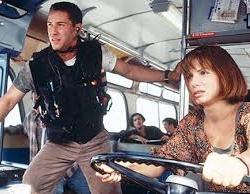
I know, I know. It’s bus rapid transit, just a bus, but do not doubt the rapid part, at least not along this highway stretch. The Silver Line runs a more local service in San Pedro and through downtown, but on the 110 and 10 past downtown out to El Monte where it ends? You fly. silverlinestop1Like a bus with Sandra Bullock in the driver’s seat.

I really should’ve kept time but we moved nearly 12 miles (including a couple stops) in what seemed like minutes, 15, 20? We certainly passed cars, stuck in traffic as they were, riding in our dedicated bus lane. It was fast. While you regular Greyhound users may not be impressed, this is a blast to someone who’s spent an inordinate time on city buses over the past 3 months or so.

Never mind the joy such a ride brings to a transit tourist like I am. How about the vital role in providing true mobility to those who really need it? It may not be pretty. It may not be particularly flashy. But there’s a real sense of empowerment, looking out of the window of a bus, traveling uncontested along the freeway, zipping past cars bogged down in congested traffic.

Public transit cannot always be just about ridership numbers and the latest, sleekest technology.  speedIt shouldn’t simply be boiled down to delivering the biggest bang for the buck. Serving up a consistent, even if only brief, boost of, I don’t know, fun and sense of unimpeded forward motion can go a long way to encouraging transit users to believe that their time matters and that the city isn’t always designed as an obstacle to them getting on with their lives.

— speedily submitted by Cityslikr