

The distant din of battle coming can be heard. A clash of cultures is in the offing. 
Toronto’s chief of medical officer of health, Dr. David McKeown, has put forth a recommendation to lower speed limits in Toronto, 30 km/h on residential streets and 40 km/h on the main streets, down from the 60-40 km/h range the city now allows. Them’s fighting words to car advocates, protectors of the status quo.
“Slow and Stupid,” the Toronto Sun front page kvetched. Underneath the headline, the photo suggested if such insanity came to pass, we’d be knocked back to 19th-century modes of transportation. Speed=modernity.
“As a general rule, especially on major arterial roadways, I think the speed limit is appropriate,” Public Works and Infrastructure Chair Denzil Minnan-Wong told the Sun’s Don Peat. 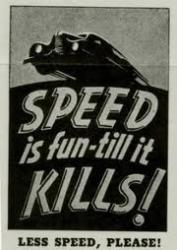
A quick look on Wikipedia shows that on residential streets, many states in America utilize 15-40 mph speed limits (24-64 km/h range). So, in fact Dr. McKeown’s suggestions aren’t that out of line crazy. At least, not socializing hot dog crazy.
As for reducing speeds to 10, 20 km/h or, heaven forbid, walking even, yes councillor, why not? Where is it written cars, trucks and other private vehicles must, must, must be allowed to drive at a speed that makes them a grievous threat to anyone else using the roads in any other manner? I know the mayor, back in the days when he was a councillor, let it be known that roads were built for busses, cars and trucks. But such Fordian Urbanism is hardly universally accepted.
Coincidentally (or perhaps not that coincidentally) an Atlantic Cities article made the rounds yesterday, The Invention of Jaywalking. In it, author of the book Fighting Traffic: The Dawn of the Motor Age in the American City, Peter Norton, asserts cars weren’t immediately granted primacy of the roads upon their appearance a century ago. In fact, many of the same fights that are being waged currently echo the ones fought back in the day.
“Streets back then were vibrant places with a multitude of users and uses” (Can you say ‘complete streets?) “When the automobile first showed up, Norton says, it was seen as an intruder and a menace. Editorial cartoons regularly depicted the Grim Reaper behind the wheel. That image persisted well into the 1920s.”
An ‘intruder’ and a ‘menace’ and those behind the wheel were held responsible for any death and destruction their machine might cause. “Norton explains that in the automobile’s earliest years, the principles of common law applied to crashes. 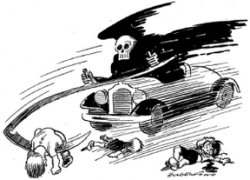
“The perjury of a murderer,” a 1923 editorial in the St. Louis Post-Dispatch thundered about any driver trying to weasel out of responsibility for the carnage inflicted by their automobile. And this, nearly a century before there was any talk of greenhouse gas emissions and climate change. Where is such righteous indignation these days?
According to Norton, the turning point came in 1925 when the city of Cincinnati moved to bring in a law capping car speeds at 25 km/h. Seeing that as a threat to the marketability of the automobile, auto clubs and dealerships fought back, brining in car manufacturers from Detroit and eventually beating back the speed cap initiative and “…promoting the adoption of traffic statutes to supplant common law. The statutes were designed to restrict pedestrian use of the street and give primacy to cars. The idea of ‘jaywalking’ — a concept that had not really existed prior to 1920 — was enshrined in law.”
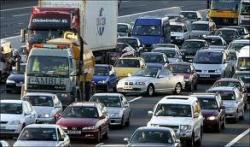
But ask drivers to slow the fuck down? Out of the question. An untenable imposition. A declaration of war.
“My heart bleeds for them when I hear someone’s got killed but it’s their own fault at the end of the day.”
The modern drivers’ creed. My space, my rules. Trespassers beware. There is a license to kill.
It didn’t used to be that way. The idea of complete streets, roads as a shared public space where all modes of traffic share equally, is not a new one, not some airy-fairy, kooky leftwing war on the car. It’s had a much longer history. 
There is no natural right of the automobile and their owners and operators. Such a privileged status and pre-eminence on our roads gained through in the trenches PR campaigns and vigilant lobbying. What’s now been termed a war on the car actually began as war on people, public spaces, communities, cities. Car owners are not the victims in this. They are the perpetrators and should be dealt with accordingly.
— retributively submitted by Cityslikr